Search / “2025年1月18日农历”
Matching Newsitems
-
-
Update from DCM - Together We Can End Homelessness
- Downtown Community Ministry
- 96 Update from DCM - Together We Can End Homelessness p{ margin:10px 0; padding:0; } table{ border-collapse:collapse; } h1,h2,h3,h4,h5,h6{ display:block; margin:0; padding:0; } img,a img{ border:0; height:auto; outline:none; text-decoration:none; } body,#bodyTable,#bodyCell{ height:100%; margin:0; padding:0; width:100%; } .mcnPreviewText{ display:none !important; } #outlook a{ padding:0; } img{ -ms-interpolation-mode:bicubic; } table{ mso-table-lspace:0pt; mso-table-rspace:0pt; } .ReadMsgBody{ width:100%; } .ExternalClass{ width:100%; } p,a,li,td,blockquote{ mso-line-height-rule:exactly; } a[href^=tel],a[href^=sms]{ color:inherit; cursor:default; text-decoration:none; } p,a,li,td,body,table,blockquote{ -ms-text-size-adjust:100%; -webkit-text-size-adjust:100%; } .ExternalClass,.ExternalClass p,.ExternalClass td,.ExternalClass div,.ExternalClass span,.ExternalClass font{ line-height:100%; } a[x-apple-data-detectors]{ color:inherit !important; text-decoration:none !important; font-size:inherit !important; font-family:inherit !important; font-weight:inherit !important; line-height:inherit !important; } .templateContainer{ max-width:600px !important; } a.mcnButton{ display:block; } .mcnImage,.mcnRetinaImage{ vertical-align:bottom; } .mcnTextContent{ word-break:break-word; } .mcnTextContent img{ height:auto !important; } .mcnDividerBlock{ table-layout:fixed !important; } h1{ color:#222222; font-family:Helvetica; font-size:40px; font-style:normal; font-weight:bold; line-height:150%; letter-spacing:normal; text-align:center; } h2{ color:#222222; font-family:Helvetica; font-size:34px; font-style:normal; font-weight:bold; line-height:150%; letter-spacing:normal; text-align:left; } h3{ color:#444444; font-family:Helvetica; font-size:22px; font-style:normal; font-weight:bold; line-height:150%; letter-spacing:normal; text-align:left; } h4{ color:#949494; font-family:Georgia; font-size:20px; font-style:italic; font-weight:normal; line-height:125%; letter-spacing:normal; text-align:left; } #templateHeader{ background-color:#0f288b; background-image:none; background-repeat:no-repeat; background-position:50% 50%; background-size:cover; border-top:0; border-bottom:0; padding-top:54px; padding-bottom:54px; } .headerContainer{ background-color:transparent; background-image:none; background-repeat:no-repeat; background-position:center; background-size:cover; border-top:0; border-bottom:0; padding-top:0; padding-bottom:0; } .headerContainer .mcnTextContent,.headerContainer .mcnTextContent p{ color:#757575; font-family:Helvetica; font-size:16px; line-height:150%; text-align:left; } .headerContainer .mcnTextContent a,.headerContainer .mcnTextContent p a{ color:#007C89; font-weight:normal; text-decoration:underline; } #templateBody{ background-color:#transparent; background-image:none; background-repeat:no-repeat; background-position:center; background-size:cover; border-top:0; border-bottom:0; padding-top:27px; padding-bottom:54px; } .bodyContainer{ background-color:transparent; background-image:none; background-repeat:no-repeat; background-position:center; background-size:cover; border-top:0; border-bottom:0; padding-top:0; padding-bottom:0; } .bodyContainer .mcnTextContent,.bodyContainer .mcnTextContent p{ color:#757575; font-family:Helvetica; font-size:16px; line-height:150%; text-align:left; } .bodyContainer .mcnTextContent a,.bodyContainer .mcnTextContent p a{ color:#007C89; font-weight:normal; text-decoration:underline; } #templateFooter{ background-color:#333333; background-image:none; background-repeat:no-repeat; background-position:center; background-size:cover; border-top:0; border-bottom:0; padding-top:45px; padding-bottom:63px; } .footerContainer{ background-color:transparent; background-image:none; background-repeat:no-repeat; background-position:center; background-size:cover; border-top:0; border-bottom:0; padding-top:0; padding-bottom:0; } .footerContainer .mcnTextContent,.footerContainer .mcnTextContent p{ color:#FFFFFF; font-family:Helvetica; font-size:12px; line-height:150%; text-align:center; } .footerContainer .mcnTextContent a,.footerContainer .mcnTextContent p a{ color:#FFFFFF; font-weight:normal; text-decoration:underline; } @media only screen and (min-width:768px){ .templateContainer{ width:600px !important; } } @media only screen and (max-width: 480px){ body,table,td,p,a,li,blockquote{ -webkit-text-size-adjust:none !important; } } @media only screen and (max-width: 480px){ body{ width:100% !important; min-width:100% !important; } } @media only screen and (max-width: 480px){ .mcnRetinaImage{ max-width:100% !important; } } @media only screen and (max-width: 480px){ .mcnImage{ width:100% !important; } } @media only screen and (max-width: 480px){ .mcnCartContainer,.mcnCaptionTopContent,.mcnRecContentContainer,.mcnCaptionBottomContent,.mcnTextContentContainer,.mcnBoxedTextContentContainer,.mcnImageGroupContentContainer,.mcnCaptionLeftTextContentContainer,.mcnCaptionRightTextContentContainer,.mcnCaptionLeftImageContentContainer,.mcnCaptionRightImageContentContainer,.mcnImageCardLeftTextContentContainer,.mcnImageCardRightTextContentContainer,.mcnImageCardLeftImageContentContainer,.mcnImageCardRightImageContentContainer{ max-width:100% !important; width:100% !important; } } @media only screen and (max-width: 480px){ .mcnBoxedTextContentContainer{ min-width:100% !important; } } @media only screen and (max-width: 480px){ .mcnImageGroupContent{ padding:9px !important; } } @media only screen and (max-width: 480px){ .mcnCaptionLeftContentOuter .mcnTextContent,.mcnCaptionRightContentOuter .mcnTextContent{ padding-top:9px !important; } } @media only screen and (max-width: 480px){ .mcnImageCardTopImageContent,.mcnCaptionBottomContent:last-child .mcnCaptionBottomImageContent,.mcnCaptionBlockInner .mcnCaptionTopContent:last-child .mcnTextContent{ padding-top:18px !important; } } @media only screen and (max-width: 480px){ .mcnImageCardBottomImageContent{ padding-bottom:9px !important; } } @media only screen and (max-width: 480px){ .mcnImageGroupBlockInner{ padding-top:0 !important; padding-bottom:0 !important; } } @media only screen and (max-width: 480px){ .mcnImageGroupBlockOuter{ padding-top:9px !important; padding-bottom:9px !important; } } @media only screen and (max-width: 480px){ .mcnTextContent,.mcnBoxedTextContentColumn{ padding-right:18px !important; padding-left:18px !important; } } @media only screen and (max-width: 480px){ .mcnImageCardLeftImageContent,.mcnImageCardRightImageContent{ padding-right:18px !important; padding-bottom:0 !important; padding-left:18px !important; } } @media only screen and (max-width: 480px){ .mcpreview-image-uploader{ display:none !important; width:100% !important; } } @media only screen and (max-width: 480px){ h1{ font-size:30px !important; line-height:125% !important; } } @media only screen and (max-width: 480px){ h2{ font-size:26px !important; line-height:125% !important; } } @media only screen and (max-width: 480px){ h3{ font-size:20px !important; line-height:150% !important; } } @media only screen and (max-width: 480px){ h4{ font-size:18px !important; line-height:150% !important; } } @media only screen and (max-width: 480px){ .mcnBoxedTextContentContainer .mcnTextContent,.mcnBoxedTextContentContainer .mcnTextContent p{ font-size:14px !important; line-height:150% !important; } } @media only screen and (max-width: 480px){ .headerContainer .mcnTextContent,.headerContainer .mcnTextContent p{ font-size:16px !important; line-height:150% !important; } } @media only screen and (max-width: 480px){ .bodyContainer .mcnTextContent,.bodyContainer .mcnTextContent p{ font-size:16px !important; line-height:150% !important; } } @media only screen and (max-width: 480px){ .footerContainer .mcnTextContent,.footerContainer .mcnTextContent p{ font-size:14px !important; line-height:150% !important; } } Help us celebrate our 50th birthday This year, DCM is celebrating 50 years of working in the city of Wellington to “focus on the needs of, and to help empower, those marginalised in the city” (DCM Constitution, 1969). This month we held our 24th annual, fundraising Bookfair, which was another huge success for DCM, with large numbers of book-lovers coming to support our work to end homelessness in Wellington. Thank you for your support of this important event - we look forward to sharing our final tally with you soon. Next month we look forward to a special photographic exhibition focussing on the many individuals and groups within our city who are very much part of our work. The exhibition will feature 50 different images, each reflecting the contribution of one kaitautoko (supporter) group, business or individual. A number of different Wellington photographers will contribute these images, and the celebration will again be a coming together of the people of Wellington to acknowledge and reconfirm our collective commitment to ending homelessness in our city. Make a note in your diaries – plan to head down to Photospace to see the beautiful images and learn more about the amazing people in your community who are part of this vision. DCM 50th Birthday Photo Exhibition 14-28 September 2019 Mon-Sat 10am-4pm Photospace Gallery 1st floor, 37 Courtenay Place Wellington <!-- --> DCM’s Dental Service gives “lives back” This month we share the story of one of DCM's amazing supporters, our dental assistant Emily Kremmer. Emily has a full-time job and is in full-time study, but she still finds time to volunteer down at DCM, where she helps take away pain and rebuild lives. Thursday is Emily Kremmer’s “free day” – at least it’s the day she’s not at her job with Wellington Periodontics or studying for her degree in public relations and communications. But this 22-year-old dental assistant spends most of her free day in the dental treatment room at DCM. For 50 years DCM has been supporting Wellington’s most marginalised, with a focus on ending homelessness in the capital. In the first instance that’s about getting people without permanent housing into a home, then DCM supports them to stay there, to learn to manage their money and look after their new whare. But it’s also very much about addressing their physical and mental health issues, including their dental health. That’s why in March 2016, in partnership with the Wellington branch of the New Zealand Dental Association, DCM began operating a fully equipped dental treatment room, staffed by dental professionals. While the dentists volunteer their time, the dental assistants may be paid or choose to volunteer. Emily – who began with a monthly shift in August 2018 but lately has been coming every week – says she’s happy to take no payment for her hours. “I really enjoy it, and it keeps me busy. I think I’d waste my day off. I work better with something to structure my day around,” she says. The people DCM works with – who they call ‘taumai’, which means ‘to settle’ – usually have little opportunity to look after their teeth and gums, so nearly all who come into DCM’s dental service are in pain. “I love taking that pain away. As soon as you numb them up, you just see them relax,” says Emily. “And when you’re taken out that painful tooth or cleaned up their gums, they’re so grateful. One patient we had in the other day said, ‘I feel like a new man. You’ve given me back my life. I feel fantastic’, so it’s really great to feel you’re making a difference. “They often ask if we’re paid, and when we say, ‘No, we’re just here to help you,’ they’re amazed. They feel like someone cares about them and values them.” Much of the work they do, Emily says, is extractions and perio-work, with the odd filling, rather than root canals and crowns. “In general dentistry, you try to keep the real tooth as much as possible but here you need to be more realistic. There’s no point in doing a root canal if the patient can’t afford the crown. A lot of our patients here don’t have access to toothbrushes and toothpaste – although we offer them these things when they leave – so we help them in a way that’s best for them. There’s a lot of calculus build-up to scrape off, which is really satisfying!” Aside from that, the Dental Service at DCM runs just like an ordinary dental clinic, she says. Emily works from 8:30am until 1:30 on days that suit her, and is very satisfied with the clinic. “Everything runs well here. It’s super well-labelled, so it’s quick and easy to find things. There’s a new steri-room and a surgery with everything we need – ultrasonic scalers, x-ray machines, very new sterilizer and bar code scanner to keep track of sterile items and equipment. “The people here at DCM are also great. So smiley and welcoming. You never feel like you’re walking into someone else’s workplace. They treat us in the Dental Service like we’re one of the family. We take part in the daily waiata and karakia that begins each day, and they even give us lunch!” While Emily works at DCM every week, most of the dentists she assists volunteer less frequently, so she values that she works alongside lots of different people. “I have learnt a lot and I’ve become really adaptable because I need to be able to work with anyone and deal with any situation. Because I meet so many dentists, I feel strongly like I’m part of the Wellington dentist community. I don’t have plans to move onto being a hygienist or dentist but if you’re a DA who has ambitions to become a dentist, there’s a real benefit to working here.” What Emily does plan to do is get involved in dental health promotion or work for a not-for-profit organisation when she finishes her communications and marketing degree. “But I hope I’ll still be able do this because I really, really enjoy it.” An obvious thought might be, isn’t it a bit smelly working with people who live in less than ideal conditions? “Sometimes, a bit,” she answers. “But you get smelly people in private practice too. And their stories are so interesting. While some are reserved and want to get out the door as soon as they leave the chair, some are really chatty and you learn all sorts of things about them. You meet so many people you’d never meet in your normal life.” And a really good thing – they don’t complain. “In private dentistry people often complain a lot about any discomfort, but these people don’t. I think they’re used to a level of discomfort and they’ve all been living with pain for such a long time that their tolerance and resilience is high. And again, they’re just so grateful for your help so they sit in the chair and let you do your job. I haven’t heard a complaint from anyone since I’ve been here.” Emily says it’s definitely changed the way she sees people sleeping or begging on the street. “Especially if I see them drinking. One patient said to me, ‘I’ve been drinking to manage the pain’. Now if I see someone drinking, I think it may be because they’ve got a sore mouth, or toothache, or gum disease that’s not manageable.” In all, Emily Kremmer highly recommends other dentists and dental assistants offer their time at DCM’s Dental Service. “It’s very easy to work here. You give whatever time you have, whenever your want – once a month, or even less if that’s all you can do. You’re given a full orientation and lots of support while you work here. “What we do at the Dental Service is humbling and rewarding. And – at the heart of it – we do really good dentistry.” <!-- --> Please help us get the message out there! Forward this email on to everyone you can think of who may be interested in books, how to respond to homelessness, photography and just generally people who are passionate about Wellington. Because together we CAN end homelessness in our city. <!-- --> Read More Success Stories Nāku te rourou, nāu te rourou, ka ora ai te iwi With your basket and my basket, the people will thrive <!-- --> Copyright © 2019 DCM. All rights reserved. Our mailing address is: DCMPO Box 6133Marion SqWellington, Wellington 6011 New ZealandAdd us to your address book Want to change how you receive these emails? You can update your preferences or unsubscribe from this list.
- Accepted from DCM alerts archive by feedreader
- Tagged as:
- photographers
- media
- dental
- books
- wellington
- art
- housing
- people
-
-
-
The artist as many other things first
- Urban Dream Brokerage
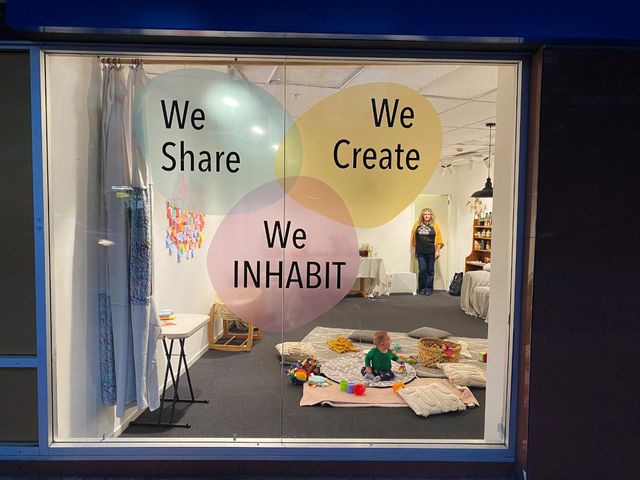
- Holly McEntegart in conversation with Anne Noble, facilitated by Mark Amery <figure class=" sqs-block-image-figure intrinsic " > Image: Anne Noble Merging her work as an artist, mother and full spectrum doula, Holli McEntegart recently brought something remarkably different to the bustle of Wellington’s Courtenay Place, in an exploration of art as a social practice. Providing a warm, calm space for participation, Inhabit brought together mothers and their infants to examine how community, cultural and whānau postpartum care has changed in Aotearoa, sharing experiences in real-time and as oral history. A private issue was brought into a public realm. Rethinking the artist’s role in society, McEntegart was supported by artist Anne Noble in a project commissioned by Letting Space for vacant space activators Urban Dream Brokerage. McEntegart now has plans to bring the project to Auckland. Here are Holli and Anne in conversation. Mark Amery Anne Noble: Letting Space and Urban Dream Brokerage have made a really remarkable contribution to the Wellington art scene. Letting Space positioned itself as an entity that sits outside the conventional domain of the gallery, where the artist is mostly defined e as a producer of objects and artefacts. They offered an experimental space and an invitation to artists to expand the ecology of contemporary art and provide support for them to provide a new kind of experience for communities and publics to engage with contemporary art I see Inhabit as a perfect example of the kind of project that Letting Space and Urban Dream Brokerage were established to nurture, enable and support. When I first thought about your ambition for Inhabit: to marry both your practices as an artist and a full spectrum doula, one of my first questions was about the expanded role of the artist in a social practice. How is your work first and foremost art while being shaped by other practices and concerns? What came to mind was a book [^1] I’ve had on my bookshelf, which has on its cover The Artist As followed by a list: that includes such descriptors of the artist as .. producer; the artist as… archivist; the artist as… ethnographer; the artist as… catalyst; the artist as… orchestrator; the artist as… poet; the artist as… curator. And it ends with this really beautiful phrase in capital letters: AND MANY OTHER THINGS FIRST. This points to the fundamental premise of your art practice - driven and formed by another whole domain of expertise, professional practice, experience and activist concerns. <figure class=" sqs-block-image-figure intrinsic " > Image: Anne Noble | Infant massage with Jo Chambers. From left: Megan Rodgers and Jasper, Jo Chambers from Blissful Bubs You define yourself as a social practice artist but you also practice as a full spectrum doula. How did you arrive at the idea of merging your practice as an artist with your life as a mother, your interest in the post-partum experience and your activism in this space? Holli McEntegart: You and I talked a lot about the artist as a conduit; or as activator. As a young artist I was always really interested in capturing images of moments that had complicated stories behind them. I realised that my interest was often more in the story; how we got to this point; the full stop. The work was always, for me, in the negotiation of getting to that image - with the image itself feeling lacklustre in comparison to that journey. Then when I moved to Pittsburgh to complete my Masters I found that there was a greater focus on social practice as a role for the artmaker. The driving need for me has always been to build relationships, and therefore community. So when I was taking photographs I would spend months getting to know people, navigating the permission, not just to be there, but to be accepted; to belong. I’ve joined every group under the sun! A loon (an aquatic bird) counting group in Maine, a porcelain painting group in Mt Albert, a bluegrass group, banjo club and a barbershop quartet in Pittsburgh, and a cake decorating group in Otara, to name a few. But I didn't feel like I had the right to be there unless I was really an accepted part of the community. That came to a head for me in Pittsburgh when I joined a semi-gated spiritualist community called Lily Dale, and began making work out of the readings they were doing for me. I would spend eight months with them before I could make that work. By the time I was living in New York there were many grants, residencies and galleries supporting a socially engaged framework of art making. My eyes were opened to the fact that this community exchange and the energy I was investing into relationship building was not only valid, it was the work.That really gave me permission to move past just documenting my work with photographs or videos and writing and to pull the focus back to the process, the making and the relationship tending. Research is a huge part of my process, whatever I’m working on I’m always off down a research tunnel. So, when I got pregnant in New York with my first child Arlo I went on a huge journey to understand pregnancy, birth and everything that was happening to my body. I discovered that in New York City, the maternal mortality rate in pregnancy, birth and early postpartum is astoundingly high, and that black women are 12 times more likely to die in childbirth than white women. OB’s are often pushing for a lot of unnecessary interventions within the hospital system and midwives are not as commonly used, though that is changing. I come from a family of home birthers in New Zealand, it was normalised and seemed like the obvious place for me to birth, but only around 1.5% of people give birth at home in the US, so it's quite a radical thing to do in that context. I was so lucky that I had a neighbour and friend who was training to be a midwife and was working as a birth doula. Through her I discovered this group of folks called doulas. I started learning about the role they play in birth work, about reproductive and birth justice advocacy, and about everything I was going to need to know to birth my baby at home while being supported by a midwife and doula team. <figure class=" sqs-block-image-figure intrinsic " > Image: Anne Noble New York City is so compact, we had a tiny apartment and I had a home studio. My son, Arlo, was born underwater, in a birth pool on my studio floor. At that point I had been working for some time within these spiritualist communities. I had been really delving into why people were seeking healing in these communities and what it meant to be constantly practising these healing rituals. Birthing my son in my studio was like an epiphany, I was on a healing journey myself and this was a part of the work. Birth was incredibly healing for me at that point in my life and then, like many people, postpartum was a completely different beast. Like most people experiencing giving birth far from their home and family, I just felt an intense lack of support from the world. And with that a deep loneliness. I was so homesick. My parents came to visit for two weeks which was incredible, but it went so fast. A few good friends showed up as best they could but I was living and working as an artist in New York, I didn’t know anyone with babies or even young kids. People are busy - for everyone else, life goes on. It’s the postpartum person that is stuck in stillness, but constantly working. It was a totally different world. You get the sense that everybody shows up for birth, everyones interested, you learn so much about pregnancy and childbirth, tracking the changes in your body all the way through to this kind of event, and then everyone leaves, and you’re left in charge of a human. It’s wild, uncharted territory and no-one’s told you that much, or what they have told you is irrelevant, biassed, outdated and sometimes even harmful. I longed for my family, mostly for my mum. I found myself floating out to sea, and there was a realisation that no one was going to rescue me - I had to rescue myself. And to do that I needed to dive even deeper into what was happening to me, go down that research tunnel again and find out what support there was in the world and how I could heal. That led to me doing Seen, a postpartum doula mentorship programme with Birdsong Brooklyn, and learning constantly - four or five months too late - what could have rescued me before I needed rescuing! It was eye opening and there was a lot of deep grief about the care I had missed out on, and the ways I could have been supported. I was diving deeply into the profoundness of becoming a mother and the reality of how much is lacking in the world in supporting new parents. I just fell in love with this idea that we could be healing collectively if we just looked after each other better and shared our knowledge. I built my community from that in New York in that first year of parenting. At that point I had been working for three years as the studio manager for an incredible artist, Janine Antoni, who is also a parent and understands that mothering work. It was a huge question for me: how do I keep working in the world as an artist, be able to show up as a mother and earn enough money to live? How do I juggle all of this and stay tethered to myself? I gave birth to my son when I was 38 and I was being called a geriatric mother by the medical system. It scared me. I wanted to breathe in my baby, just inhale him and not miss a second. But how do I do that and keep up my practice? Well… I just gave birth to my son in my studio…. It was these layers of realisation: this labour is the work. I have to reframe my life so that this labour of the home, the labour of care, of mothering, is seen and valued. So I left my job in the studio with Janine and went straight into postpartum doula training. I needed to be immersed in the community in the same way I had been with the spiritualists or the cake decorators or the bird counters in Maine. <figure class=" sqs-block-image-figure intrinsic " > Image: Holli McEntegart | Multiples Feeding Support Group. From left: Jessie Lee Broadbent, anon Anne: You have talked about your journey as a photographer engaging with communities, and how the outcome can be separated from those experiences that feel like part of the work. That is n true for many documentary photography projects.You’ve also described beautifully your dissatisfaction with being both outside a subject and yet needing to be right in the heart of it. The notion of a social practice artist is less common in New Zealand than in the US. It has currency in art schools, but my instinct when we first met and talked was that you have a really highly evolved practice in which you prioritise your relationship as an artist to the post-partum communities you engage with Your work begins with you your life as a mother and your practice as a doula being the site of public art activism, of making the post-partum world experience shared and visible. How have you then addressed the visibility of this as an artwork? You only need to look at the project website to see the level of community engagement and the number of people you have drawn into this space. It’s really significant. Those workshops - people flocked to them. But to make it public, visible to participants and to audiences how does that work? Holli: What comes first for me is the relationship, being a good community member and trust. I come at relationship building and getting people involved with their whole heart; with a genuine interest and respect. I have to have something at risk as well. Inhabit was a year in the making, but the day we opened, with a multiples lactation support workshop. We had six twin mums and probably six assistants or helpers, including grandmas, friends, lactation and doula support. That's 12 babies plus Indigo [Holli’s own baby]. Over 24 bodies breathing life into the space. That was the moment that the work became art; that it became an artwork. It was activated by the community of people in the room and their energy. Up until then there’s a lot of risk on my part because I don’t know who is going to show up and what they will bring on the day. The work is filled with intention but it has to meet people where they are and vice versa, and for that reason, it’s never the same, it evolves and unfolds and, much like mothering, I must surrender to it. I think I’m comfortable leaning into the unknown. Within a socially engaged practice you really don’t know how your participants or your audience (the public) are going to enter the work. I consider the folks facilitating workshops my co-creators. There were six months of emailing and zoom conversations about what I was making with that final group of people, so many conversations about what the community needed. And then there was a point when they came to me with a plan to set up this specific workshop for multiples families. They were asking for my permission, and I was overjoyed because, it was at that point that they took ownership and really began to have agency within the work. That was the moment when the community was activated, they started creating what they needed under the umbrella that I offered - this community activation was where the social practice aspect of the work really came into play. <figure class=" sqs-block-image-figure intrinsic " > Image: Milan Maric | Combined yoga and Infant massage workshop with Emma Chen Flitcroft and Jo Chambers I was coming to Wellington, into a community I’m not from, so I’m constantly asking myself, how do I leave this space better than when I got here? Within social practice I think there is a very real responsibility to care for the community you're working in and to make sure there are ongoing care agreements in that community. Everyone that provided a workshop for Inhabit offers free or sliding scale services that could continue to be accessed after Inhabit closed for example. Anne: That’s a beautiful description of the artist as catalyst. I’m very fond of the notion that when an artist plays those roles, the artist in a conventional sense disappears to become a generating and catalysing force Holli: I’m interested in the way my role shifted from facilitator to participant, or mother , or host. Hourly that changed. Originally I thought I would be facilitating some workshops but I didn't end up doing that because so many people wanted to facilitate their own. At the beginning of each workshop I would introduce the project and really ground it back into the context of an artwork, to remind people they were participating in something both bigger than them, but also inherently generated by them, and then I would participate alongside them. I was never an observer, I was a participant. I think it’s really important I have the ability to be part of what’s happening as opposed to being an outsider. Learning, participating and being vulnerable. That vulnerability permissions other people in the space to also be vulnerable. It’s not like, as you’re describing Anne, that ‘‘you’re the artist and you’re over there’ on a pedestal. The process is about me sinking back into the work. It’s a dance between making sure people feel like they are being held and acknowledged and the space is being tended to in the correct way, but not dominating it. <figure class=" sqs-block-image-figure intrinsic " > Image: Anne Noble Anne: As a public artwork, positioned in Courtenay Place, it was a really beautiful intervention with really subtle signage and this glowing light masked by a wall of handmade stitched together nappies! It offered a surprising encounter that was intriguingly signposted and people were welcomed to just stop and to consider what it might be - as a public art project. Sometimes I was amazed at the number of people participating and how the work created an opportunity for a community to assemble. How did you introduce participants to the process of being part of something for them but also part of something larger? Of being participants and collaborators in Inhabit as an artwork. Holli: That was definitely one of my biggest challenges. There were a couple of things I did practically. Even before Inhabit opened I worked very hard to centre the project in the community with this drawing project that involved - six Love Note posters that were plastered repetitively around the city in the two weeks leading up to our opening. I was documenting them in situ and sending images of them to people when they were signing up for the workshops as well as using them in social media. So there was a centring of it as an art project before they arrived. Most people had seen these drawings and then saw the wall of Love Notes growing on the wall when they came into the space. I introduced that as a collaborative drawing project and really impressed the importance of adding everyone's voice to that growing archive. <figure class=" sqs-block-image-figure intrinsic " > Image: Lily Dowd I constantly was re-centring it as an artwork in this way all the time, and encouraging the public to participate, reminding them of what they are a part of. I see the Love Notes as the beginning of an archive of postpartum stories - a collection. And that maybe this is how we start something: a movement, a book, an archive - we just have to start putting our stories on the wall. I think that grew really organically and became a way for people to gently be reminded of the fact that they were a part of an artwork, and then they forgot about it - which was great. Someone hands them a bowl of soup, nourishes them, checks in and makes sure they’re OK. Offers to hold their baby. and that energy of care flows into the space and people feel really comfortable. And that comfort was there in part because I was there visibly parenting, making the work. Creating a space that makes visible the lived experience of parenting, and artmaking at the same time. <figure class=" sqs-block-image-figure intrinsic " > Image: Anne Noble As it transpired there was very little foot traffic, and actually the space needed to be very protected, intimate and gate kept. So the curtain that I made really provided a level of intimacy. It is another drawing project I had been working on as a part of the show, but I didn’t quite know where it would fit. I’ve been collecting these used flat nappies. They are very identifiable, heavily washed and starched white cotton with a red stripe down the side. They are the kind of do everything cloth of motherhood. So representative of the labour of the home. Soaking up the mess of it all. I’ve been stamping all over them with my own mother at my kitchen table, “Ssshhhhhh sshhh shhh ssshhh shh shh shh…” On the first day of installation it was clear to me that we needed to be able to transform the space into a private, intimate one, and to open it up to the world. Sewing the nappies together to make a curtain was a wonderful way to create that boundary between public and private. And then at the end of the last workshop I was really inspired to “pull back that curtain” and be seen. I called you and asked you to document this moment of being seen in parenting and artmaking. It was such a moment of connectivity and community connection. There’s now two groups I believe that came together at Inhabit and are continuing to meet. It was great to cultivate this level of nurturance and community engagement in a place like Courtenay Place - buses, cars and people with so much going-to-work energy, once we pulled back that curtain I think people were taken aback by it “there are so many babies!” <figure class=" sqs-block-image-figure intrinsic " > Image: Milan Maric | Combined yoga and Infant massage workshop with Emma Chen Flitcroft and Jo Chambers Anne: Yes it was a brightly lit window that glowed like a little jewel! And was such a surprising experience walking by. You’ve described the artist as a generator and how there is a legacy for participants beyond the exhibition space. What were some of the highpoints during Inhabit and some of those legacies? Holli: The highest high was our opening, that first day. 13 babies in the space. One of the sets of twins was only five weeks old and it was their first time out of the house and their mum had driven an hour to get there, they spent all day with us. Any future Inhabit projects will always open with a multiples workshop because these folks are the least catered for within the system. The world was not made for people birthing two or three babies at a time… So to have this space where people were surrounded by support and advice and understanding. It was so magic and it was so clear there was a need for that. I think that in the current Covid climate people are feeling so much more isolated and unable to get out of the house. Opportunities for connection that were available to parents pre covid often aren't now, like community or library meetups and coffee groups. Many people were speaking of coming to Inhabit as the first time they’d been to a group outside the home, there is a lot of isolation and fear out there, and a deep lack in support services. A few people who weren’t parents had some very interesting interactions with the space as an artwork, which I found fascinating. Some really generative conversations came from them being confronted: that they were coming to a public exhibition, and were questioning ‘what is this?!’ I had very interesting conversations with other artists about what participation looks like when you’re not a parent. For parents their participation was organic but for others, it felt very different. They accessed it through my facilitation and it was interesting seeing them sink into comfort because they were being cared for; getting down on the floor and playing with Indigo. Having some soup, and learning about traditions of postpartum care and methodologies. I’m interested in pulling back the veil on this kind of care work because we can all benefit from learning how to tend to our communities and families. <figure class=" sqs-block-image-figure intrinsic " > Image: Milan Maric Another highlight was my involvement with Little Shadow. They run perinatal mental health support groups in the Wellington region and virtually across the motu. They were so supportive of this project. They really saw the power of what Inhabit created in offering an entrance point to conversations about perinatal mental health that are softer and more nurturing than how it’s often tackled when people are looking for support within a healthcare system. Inhabit provides nourishing food, a space to express yourself creatively, a place to move your postpartum body, and a room full of folks on a similar path. Once there, we are able to get into the nitty gritty of what we are all experiencing because the space itself is so tended to. Something that I repeat all the time is that I’m examining patterns of care, whilst caring for our communities. I want to decolonise postpartum care so that we may all gain the knowledge of how to care for each other. Then there was that final reveal, pulling back that curtain. I felt I was truly being seen as my whole self in the work. Before that point I was a shapeshifter facilitating everybody else's journey. But at that moment I was in my deeply creative space of making and mothering as I finished the project. It felt like closure and an answer to that question of how I can be an artist, make work and be a parent. It struck me how that question has deeply impacted my relationships with people and how I move in the world. In my first few days in Wellington I had a clear vision of that image we captured at the end. I saw the room glowing with light, semi dark outside and the interior being a place of making and of process. A gallery, and a living room and a studio and a feeding place. Where bums are getting changed, a place where all of life is happening at the same time. And that the public are walking past and peeking in. The labour of parenthood and of artmaking is usually so invisible. That moment at the end just felt like: let’s get it all on display! <figure class=" sqs-block-image-figure intrinsic " > Image: Milan Maric <figure class=" sqs-block-image-figure intrinsic " > Image: Milan Maric Anne: I love what you say about risk. Because if art doesn't involve risk it doesn't leave the opportunity for engagement - If it's there and says it all it doesn’t ask very much of people. The way both your processes of making and lived experience are entirely central to the work raises questions for people coming in off the street - challenging their notions about art - and confronts them with the invisibility of the post-partum experience. Can you talk about how Inhabit is an evolving work? How it’s more than a one-off event where communities come together and are potentially transformed. How is the website a part of the evolution of the work? Holli: If you are thinking about community engagement and looking at different types of communities' needs then you’ve got to move around those communities. My vision for Inhabit was always that it would move around the motu. One of the things I thought was important about the experience in Wellington was that it felt disruptive. It felt radical. It was an interesting way to inhabit vacant space in the CBD and disrupt a community. It ignited something that people were aware they needed, but no-one knew how to connect on and build. <figure class=" sqs-block-image-figure intrinsic " > Image: Anne Noble I think there’s a lot of power in Inhabit travelling around regionally and disrupting systems in ways that are really positive and ignite connection. I think of little things growing, sprouting. And of having this homebase of an archive online where we can collect and hold these postpartum stories and learn from what we’ve been doing here to better support communities. Anne: Thanks Holli - for the pleasure of being a small part of this project with you. Anne Noble (Laureate), ONZM, is a photographer and curator whose work spans still and moving image, installation and international curatorial commissions. Over multiple projects Annne Noble has considered the significance of memory and imagination to personal and cultural narratives of place and belonging.Holli McEntegart is an interdisciplinary artist using social practice, video, performance, photography and text. She holds a Bachelor of Visual Arts in Photography (NZ), and a Masters of Visual Art and Design from Auckland University of Technology (NZ), which included a one year MFA scholarship at Carnegie Mellon School of Art, Pittsburgh (USA). In 2014 she was an artist in residence at the Skowhegan School of Painting & Sculpture in Maine (USA). Her work has been performed and exhibited throughout the USA and New Zealand. In 2018 she trained as a Full Spectrum Doula after giving birth to her first son in Brooklyn, New York. Returning to Aotearoa in 2020, where she continues her work as an artist and as a Reproductive Justice Advocate. Holli is now an island named Mother to two boys, aged 4 and 9 months. <figure class=" sqs-block-image-figure intrinsic " > Image: Holli McEntegart | Multiples Feeding Support Group - From left; Anon, Georgie Manning, Jessie [^1]: Aileen Burns, Tara McDowell, and Johan Lundh, The Artist As Producer, Quarry, Thread, Director, Writer, Orchestrator, Ethnographer, Choreographer, Poet, Archivist, Forger, Curator, and Many Other Things First. Institute of Modern Art, Brisbane, Curatorial Practice at Monash University, Melbourne and Sternberg Press, 2018.
- Accepted from Urban Dream Brokerage Blog by feedreader
- Tagged as:
- brooklyn
- covid-19
- exhibitions
- libraries
Brooklyn, Wellington, New Zealand (OpenStreetMap)
-
-
-
Ngā Kōrero - Latest stories from DCM
- Downtown Community Ministry
- 96 Ngā Kōrero - Latest stories from DCM p{ margin:10px 0; padding:0; } table{ border-collapse:collapse; } h1,h2,h3,h4,h5,h6{ display:block; margin:0; padding:0; } img,a img{ border:0; height:auto; outline:none; text-decoration:none; } body,#bodyTable,#bodyCell{ height:100%; margin:0; padding:0; width:100%; } .mcnPreviewText{ display:none !important; } #outlook a{ padding:0; } img{ -ms-interpolation-mode:bicubic; } table{ mso-table-lspace:0pt; mso-table-rspace:0pt; } .ReadMsgBody{ width:100%; } .ExternalClass{ width:100%; } p,a,li,td,blockquote{ mso-line-height-rule:exactly; } a[href^=tel],a[href^=sms]{ color:inherit; cursor:default; text-decoration:none; } p,a,li,td,body,table,blockquote{ -ms-text-size-adjust:100%; -webkit-text-size-adjust:100%; } .ExternalClass,.ExternalClass p,.ExternalClass td,.ExternalClass div,.ExternalClass span,.ExternalClass font{ line-height:100%; } a[x-apple-data-detectors]{ color:inherit !important; text-decoration:none !important; font-size:inherit !important; font-family:inherit !important; font-weight:inherit !important; line-height:inherit !important; } .templateContainer{ max-width:600px !important; } a.mcnButton{ display:block; } .mcnImage,.mcnRetinaImage{ vertical-align:bottom; } .mcnTextContent{ word-break:break-word; } .mcnTextContent img{ height:auto !important; } .mcnDividerBlock{ table-layout:fixed !important; } h1{ color:#222222; font-family:Helvetica; font-size:40px; font-style:normal; font-weight:bold; line-height:150%; letter-spacing:normal; text-align:center; } h2{ color:#222222; font-family:Helvetica; font-size:34px; font-style:normal; font-weight:bold; line-height:150%; letter-spacing:normal; text-align:center; } h3{ color:#444444; font-family:Helvetica; font-size:22px; font-style:normal; font-weight:bold; line-height:150%; letter-spacing:normal; text-align:center; } h4{ color:#949494; font-family:Georgia; font-size:20px; font-style:italic; font-weight:normal; line-height:125%; letter-spacing:normal; text-align:center; } #templateHeader{ background-color:#07486a; background-image:none; background-repeat:no-repeat; background-position:50% 50%; background-size:cover; border-top:0; border-bottom:0; padding-top:54px; padding-bottom:54px; } .headerContainer{ background-color:transparent; background-image:none; background-repeat:no-repeat; background-position:center; background-size:cover; border-top:0; border-bottom:0; padding-top:0; padding-bottom:0; } .headerContainer .mcnTextContent,.headerContainer .mcnTextContent p{ color:#757575; font-family:Helvetica; font-size:16px; line-height:150%; text-align:left; } .headerContainer .mcnTextContent a,.headerContainer .mcnTextContent p a{ color:#007C89; font-weight:normal; text-decoration:underline; } #templateBody{ background-color:#transparent; background-image:none; background-repeat:no-repeat; background-position:center; background-size:cover; border-top:0; border-bottom:0; padding-top:27px; padding-bottom:54px; } .bodyContainer{ background-color:#transparent; background-image:none; background-repeat:no-repeat; background-position:center; background-size:cover; border-top:0; border-bottom:0; padding-top:0; padding-bottom:0; } .bodyContainer .mcnTextContent,.bodyContainer .mcnTextContent p{ color:#757575; font-family:Helvetica; font-size:16px; line-height:150%; text-align:left; } .bodyContainer .mcnTextContent a,.bodyContainer .mcnTextContent p a{ color:#007C89; font-weight:normal; text-decoration:underline; } #templateFooter{ background-color:#07486a; background-image:none; background-repeat:no-repeat; background-position:center; background-size:cover; border-top:0; border-bottom:0; padding-top:45px; padding-bottom:63px; } .footerContainer{ background-color:transparent; background-image:none; background-repeat:no-repeat; background-position:center; background-size:cover; border-top:0; border-bottom:0; padding-top:0; padding-bottom:0; } .footerContainer .mcnTextContent,.footerContainer .mcnTextContent p{ color:#FFFFFF; font-family:Helvetica; font-size:12px; line-height:150%; text-align:center; } .footerContainer .mcnTextContent a,.footerContainer .mcnTextContent p a{ color:#FFFFFF; font-weight:normal; text-decoration:underline; } @media only screen and (min-width:768px){ .templateContainer{ width:600px !important; } } @media only screen and (max-width: 480px){ body,table,td,p,a,li,blockquote{ -webkit-text-size-adjust:none !important; } } @media only screen and (max-width: 480px){ body{ width:100% !important; min-width:100% !important; } } @media only screen and (max-width: 480px){ .mcnRetinaImage{ max-width:100% !important; } } @media only screen and (max-width: 480px){ .mcnImage{ width:100% !important; } } @media only screen and (max-width: 480px){ .mcnCartContainer,.mcnCaptionTopContent,.mcnRecContentContainer,.mcnCaptionBottomContent,.mcnTextContentContainer,.mcnBoxedTextContentContainer,.mcnImageGroupContentContainer,.mcnCaptionLeftTextContentContainer,.mcnCaptionRightTextContentContainer,.mcnCaptionLeftImageContentContainer,.mcnCaptionRightImageContentContainer,.mcnImageCardLeftTextContentContainer,.mcnImageCardRightTextContentContainer,.mcnImageCardLeftImageContentContainer,.mcnImageCardRightImageContentContainer{ max-width:100% !important; width:100% !important; } } @media only screen and (max-width: 480px){ .mcnBoxedTextContentContainer{ min-width:100% !important; } } @media only screen and (max-width: 480px){ .mcnImageGroupContent{ padding:9px !important; } } @media only screen and (max-width: 480px){ .mcnCaptionLeftContentOuter .mcnTextContent,.mcnCaptionRightContentOuter .mcnTextContent{ padding-top:9px !important; } } @media only screen and (max-width: 480px){ .mcnImageCardTopImageContent,.mcnCaptionBottomContent:last-child .mcnCaptionBottomImageContent,.mcnCaptionBlockInner .mcnCaptionTopContent:last-child .mcnTextContent{ padding-top:18px !important; } } @media only screen and (max-width: 480px){ .mcnImageCardBottomImageContent{ padding-bottom:9px !important; } } @media only screen and (max-width: 480px){ .mcnImageGroupBlockInner{ padding-top:0 !important; padding-bottom:0 !important; } } @media only screen and (max-width: 480px){ .mcnImageGroupBlockOuter{ padding-top:9px !important; padding-bottom:9px !important; } } @media only screen and (max-width: 480px){ .mcnTextContent,.mcnBoxedTextContentColumn{ padding-right:18px !important; padding-left:18px !important; } } @media only screen and (max-width: 480px){ .mcnImageCardLeftImageContent,.mcnImageCardRightImageContent{ padding-right:18px !important; padding-bottom:0 !important; padding-left:18px !important; } } @media only screen and (max-width: 480px){ .mcpreview-image-uploader{ display:none !important; width:100% !important; } } @media only screen and (max-width: 480px){ h1{ font-size:30px !important; line-height:125% !important; } } @media only screen and (max-width: 480px){ h2{ font-size:26px !important; line-height:125% !important; } } @media only screen and (max-width: 480px){ h3{ font-size:20px !important; line-height:150% !important; } } @media only screen and (max-width: 480px){ h4{ font-size:18px !important; line-height:150% !important; } } @media only screen and (max-width: 480px){ .mcnBoxedTextContentContainer .mcnTextContent,.mcnBoxedTextContentContainer .mcnTextContent p{ font-size:14px !important; line-height:150% !important; } } @media only screen and (max-width: 480px){ .headerContainer .mcnTextContent,.headerContainer .mcnTextContent p{ font-size:16px !important; line-height:150% !important; } } @media only screen and (max-width: 480px){ .bodyContainer .mcnTextContent,.bodyContainer .mcnTextContent p{ font-size:16px !important; line-height:150% !important; } } @media only screen and (max-width: 480px){ .footerContainer .mcnTextContent,.footerContainer .mcnTextContent p{ font-size:14px !important; line-height:150% !important; } } Looking back into the past, and toward the future, Jason remembers kindness – “The biggest thing on my list today.” Building commuities where whānau are housed, connected, valued and thriving About Us Contact Healing through kindness – Jason’s story It’s a cold mid-winter’s Monday morning at DCM, and the building is bustling with activity. Jason has just arrived for work, and there’s plenty to be done. Jason is going to show a new volunteer the ropes. Food awaits pick-up at some local churches, Kaibosh and New World – and when the DCM van returns back to base Jason will have food parcels to pack so taumai can receive emergency food assistance. For Jason, employed as kaiāwhina in DCM’s Foodbank, he knows that there are lots of little ways he can help. For example, “If someone needs an overnight food parcel, chances are they’re rough sleeping. So I’ll go out of my way to make sure they have some disposable containers, tear tabs – I couldn’t think of anything worse than being given some food and not being able to eat it!” Another day in DCM's busy Foodbank. Jason describes it as a selfless job. “It really gets me out of my own way, to help share the vision of DCM. I always walk away at the end of my shift feeling better about myself.” Looking back into the past, and toward the future, Jason remembers kindness. But life was not always kind to Jason, and he is remarkably honest about his journey. Jason was born in the Hawke’s Bay, where family life was pretty tough. “I had an alcoholic stepfather who brought violence into the home,” Jason shares. “My mum was trying to raise me and my two brothers and she kind of got trapped in this relationship and couldn’t escape.” Jason came out when he was quite young, and he was bullied at school. This had a big impact on him, as did working in hospitality from a young age. Jason is reflective about how drugs and alcohol helped him to suppress his emotions. “So you have the cultural aspects, and the family harm aspects, and also depression runs right through my family. I didn’t have good coping mechanisms. So one thing I learned is that when things get tough you just pack up and run. “I learned to pack very lightly, and not put roots down. I couch surfed, spending many years doing that. I learned that all your possessions are the clothes on your back, and what you can carry.” Jason was thrown out of places for not paying rent due to his drug problem, ending up in Australia. But despite the change of scene, and a good job in hospitality, Jason acknowledges, “I thought life would be OK. But I still hadn’t addressed that I had a drug and alcohol problem. Or that I was an addict.” It was back in New Zealand that Jason reached what he describes as his lowest point. “I remember getting to a point where I’d use drugs, walk around the house, and felt like I just ‘existed’. That was a scary feeling. I just felt empty, like I had nothing.” With family help, Jason was finally able to start the process of getting into rehab. That took four months, and in the meantime Jason started going to 12-step meetings, and anything he could find that was recovery-focussed. “I found online blogs of people sharing stories about how they managed to give up drugs, and I was drawn to that kōrero,” Jason says. “I thought, ‘Hang on, there’s a life outside this?’” After a relapse, Jason found himself rough sleeping. He went to Work and Income to ask for help with emergency housing, and they suggested popping down to DCM to get some food, where Dominic was his first point of contact. “I was a mess, but Dom was really kind. He helped me with a food parcel and then we had a bit of a kōrero about how DCM could help. I was willing to take whatever help I could get, and he said that Evan had just started at DCM, and that he would like to engage me with him. I wasn’t too keen on meeting a drug and alcohol counsellor! I just wanted to isolate in my own little bubble, and wallow in my pity. But as I was walking out of the interview room, Dom goes, ‘Oh, this is Evan here!’ So I didn’t have a choice in the matter! And that was kind of a turning point in my life.” Jason with DCM drug and alcohol counsellor Evan. From then, Jason started popping down to DCM regularly. “I would come down most mornings, even if it was only for a coffee and a chat to the staff. Just so that they had ‘eyes’ on me. I started opening my doors for change. I just let DCM in. “I maintained going to regular meetings – every single day, even when I didn’t want to. I joined Te Awatea. I would go along Mondays and Fridays. And have a kōrero in there with the other taumai, sharing my journey, and what was going on for me. It is so good that there is a safe space at DCM for people to speak openly and honestly. “Evan used to call me, saying ‘Hey brother, I’ve put your name down for this. If you’re not interested, you don’t have to do it’. As I started getting better I decided to take up the challenge of doing the things that scared me the most. And one of those things was doing the peer support training with Brodie and Hannah at DCM.” Jason was able to access other services at DCM, such as the emergency dental service. “I was terrified of seeing the dentist!” Jason explains. “I hadn’t looked after myself, but the dentist (Morris Wong) was amazing. He sees people. He talked me through my anxiety. It wasn’t as bad as I expected. I needed a tooth extraction and a filling, probably two things people fear the most. And he helped me through it. I went away thinking, ‘Wow, what a great experience!’” Jason also saw the Te Aro Health nurses at DCM. “Don’t even get me started on them! Rebecca and Bronwyn have been incredible, and super-supportive. I went to Bronwyn with a medical problem and she made it her business to push for the hospital to see me. They helped me, and it’s been great. She went above and beyond, just pushing for them to do something. “All the staff at DCM are amazing,” Jason adds. “All the staff who are there now, and those who have moved on.” Having completed training with PeerZone, another kaiāwhina (Renee) suggested Jason apply for a job working in the DCM Foodbank. “She set up an interview and I was absolutely terrified about going into a job. I hadn’t been in employment for eight years. I didn’t know if I’d be any good or be able to hold the job down. So much unknown, but I used a bit of courage. Then I thought, actually, the job’s not about me. I found purpose in the job and that’s about knowing that the mahi that I’m doing is impacting the lives of others today. “I used to give money to street beggars – until Evan pointed out the dangers. If I’m walking down the street now and hear a taumai calling out to ask for money I say, ‘If you’re hungry, pop down to DCM. WE can help.’” Jason now has a whare with help from Evan and DCM's Aro Mai Housing First team. He is proud to be housed, working, and officially off Work and Income’s books. He’s even ditched cigarettes. But most of all, Jason is proud to be living clean, one day at a time. “What I have learned in that time is to show others compassion and kindness. And that comes from the people who have loved me since walking through the doors at DCM. I wasn’t judged and they were there to help me. So today I try to see people and meet them where they’re at. I’m continuing to show that love and kindness to others.” Jason now has a life he never dreamed he’d have. “Some days I still feel like an alien trapped in my own body. I definitely don’t have it all together – but that’s OK. I’m on the right path. I’ve had many months of re-building my Te Whare Tapa Whā. I’ve learned core values and spiritual principles along the way. I’m a better person today, and I’m OK with who I am. “When I look back to my darkest times, what stands out to me the most are those who showed me kindness. Those who were able to be there for me, to say ‘It’s OK. It won’t be like this forever.’ “So I remember kindness – that’s the biggest thing on my list today.” Photoshoot by Gabrielle McKone. <!-- --> Te Awatea – Doing whatever it takes It's later on Monday morning at DCM – almost 11am. “Last call for coffee!” Clifton announces to the room. Some taumai get their final cup, while others mill around, waiting for Te Awatea to begin. Evan and Jo have set up the space, where taumai are welcome to come and go. They are joined by Clifton and other kaiāwhina, offering peer support for the group. Te Awatea is as accommodating as possible, though Evan and Jo will keep an eye on disruptions, and manage any behaviour that starts to impact other members of the group. Te Awatea is all about harm reduction – and today the nine members of the group start with a round of, “How are you doing today, on a scale of 1-10?” Some taumai rate themselves pretty high, a 7 or 8, while others are feeling a bit down today. A couple of taumai are dealing with medical issues at the moment, which is not making life any easier. Everyone shares how their weekend went. For some taumai, there are challenges. There are members of the group who freely share that they are dependent on drugs or alcohol, and feel stuck. But there’s no judgement from Evan and Jo, or from other taumai in the room. This is a safe space to share whatever you’re feeling, wherever you’re at. One taumai has to leave early to see a nurse. Before he goes he shares how he’s managed to reduce his alcohol intake. He had a great weekend, and is feeling good today. The group cheer him on – “Awesome mahi!” – as he pops out to see the Te Aro Health team. After the intros, Evan leads a kōrero about mental health. By sharing some of his story Evan knows that it will help break the ice, and get the group to open up about their own experiences. Taumai share how they face mental health challenges too, and some acknowledge that they use drugs and alcohol to self-medicate, but that it doesn’t really help. There are a lot of laughs at Te Awatea. Everyone is different – and there are some characters! – but everyone is so open and honest that it’s hard not to share in a joke or two, to lift the spirit in the room. As the session comes to a close Evan leads with the serenity prayer, “Grant me the serenity to accept the things I cannot change; courage to change the things I can; and wisdom to know the difference.” Taumai chat amongst themselves as they head off. Some are looking forward to the next session, which will take place on Friday. In the meantime, Evan and Jo have their own little side room at DCM for one-on-one sessions with taumai who need them. While the group focusses on harm reduction, the offer of other pathways forward is always there if that’s what it takes for taumai to thrive. “Whatever it takes” is part and parcel of DCM’s kaupapa. Te Awatea truly shows that kaupapa in action. It’s not just on Mondays we hear stories like these. Here at DCM we are privileged to journey with taumai towards their housing and wellbeing aspirations, each and every day. You can help support us by forwarding this email on to anyone you think may be interested in learning more about our mahi. We will share our Ngā Kōrero bi-monthly. <!-- --> Support DCM We call the people we work with taumai, meaning to settle. This reflects the journey we set out on together – to become settled, stable and well. Nāku te rourou, nāu te rourou, ka ora ai te iwi. With your basket and my basket, the people will thrive. <!-- --> Copyright © 2022 DCM. All rights reserved. Our mailing address is: DCMPO Box 6133Marion SqWellington, Wellington 6011 New ZealandAdd us to your address book Want to change how you receive these emails? You can update your preferences or unsubscribe from this list.
- Accepted from DCM alerts archive by feedreader
- Automatically tagged as:
- religious-groups
-
-
-
DCM Bookfair 2018 - One Week to Go!
- Downtown Community Ministry
- 96 DCM Bookfair 2018 - One Week to Go! p{ margin:10px 0; padding:0; } table{ border-collapse:collapse; } h1,h2,h3,h4,h5,h6{ display:block; margin:0; padding:0; } img,a img{ border:0; height:auto; outline:none; text-decoration:none; } body,#bodyTable,#bodyCell{ height:100%; margin:0; padding:0; width:100%; } .mcnPreviewText{ display:none !important; } #outlook a{ padding:0; } img{ -ms-interpolation-mode:bicubic; } table{ mso-table-lspace:0pt; mso-table-rspace:0pt; } .ReadMsgBody{ width:100%; } .ExternalClass{ width:100%; } p,a,li,td,blockquote{ mso-line-height-rule:exactly; } a[href^=tel],a[href^=sms]{ color:inherit; cursor:default; text-decoration:none; } p,a,li,td,body,table,blockquote{ -ms-text-size-adjust:100%; -webkit-text-size-adjust:100%; } .ExternalClass,.ExternalClass p,.ExternalClass td,.ExternalClass div,.ExternalClass span,.ExternalClass font{ line-height:100%; } a[x-apple-data-detectors]{ color:inherit !important; text-decoration:none !important; font-size:inherit !important; font-family:inherit !important; font-weight:inherit !important; line-height:inherit !important; } #bodyCell{ padding:10px; } .templateContainer{ max-width:600px !important; } a.mcnButton{ display:block; } .mcnImage,.mcnRetinaImage{ vertical-align:bottom; } .mcnTextContent{ word-break:break-word; } .mcnTextContent img{ height:auto !important; } .mcnDividerBlock{ table-layout:fixed !important; } body,#bodyTable{ background-color:#FAFAFA; } #bodyCell{ border-top:0; } .templateContainer{ border:0; } h1{ color:#202020; font-family:Helvetica; font-size:26px; font-style:normal; font-weight:bold; line-height:125%; letter-spacing:normal; text-align:left; } h2{ color:#202020; font-family:Helvetica; font-size:22px; font-style:normal; font-weight:bold; line-height:125%; letter-spacing:normal; text-align:left; } h3{ color:#202020; font-family:Helvetica; font-size:20px; font-style:normal; font-weight:bold; line-height:125%; letter-spacing:normal; text-align:left; } h4{ color:#202020; font-family:Helvetica; font-size:18px; font-style:normal; font-weight:bold; line-height:125%; letter-spacing:normal; text-align:left; } #templatePreheader{ background-color:#fafafa; background-image:none; background-repeat:no-repeat; background-position:center; background-size:cover; border-top:0; border-bottom:0; padding-top:9px; padding-bottom:9px; } #templatePreheader .mcnTextContent,#templatePreheader .mcnTextContent p{ color:#656565; font-family:Helvetica; font-size:12px; line-height:150%; text-align:left; } #templatePreheader .mcnTextContent a,#templatePreheader .mcnTextContent p a{ color:#656565; font-weight:normal; text-decoration:underline; } #templateHeader{ background-color:#FFFFFF; background-image:none; background-repeat:no-repeat; background-position:center; background-size:cover; border-top:0; border-bottom:0; padding-top:9px; padding-bottom:0; } #templateHeader .mcnTextContent,#templateHeader .mcnTextContent p{ color:#202020; font-family:Helvetica; font-size:16px; line-height:150%; text-align:left; } #templateHeader .mcnTextContent a,#templateHeader .mcnTextContent p a{ color:#2BAADF; font-weight:normal; text-decoration:underline; } #templateBody{ background-color:#FFFFFF; background-image:none; background-repeat:no-repeat; background-position:center; background-size:cover; border-top:0; border-bottom:2px solid #EAEAEA; padding-top:0; padding-bottom:9px; } #templateBody .mcnTextContent,#templateBody .mcnTextContent p{ color:#202020; font-family:Helvetica; font-size:16px; line-height:150%; text-align:left; } #templateBody .mcnTextContent a,#templateBody .mcnTextContent p a{ color:#2BAADF; font-weight:normal; text-decoration:underline; } #templateFooter{ background-color:#FAFAFA; background-image:none; background-repeat:no-repeat; background-position:center; background-size:cover; border-top:0; border-bottom:0; padding-top:9px; padding-bottom:9px; } #templateFooter .mcnTextContent,#templateFooter .mcnTextContent p{ color:#656565; font-family:Helvetica; font-size:12px; line-height:150%; text-align:center; } #templateFooter .mcnTextContent a,#templateFooter .mcnTextContent p a{ color:#656565; font-weight:normal; text-decoration:underline; } @media only screen and (min-width:768px){ .templateContainer{ width:600px !important; } } @media only screen and (max-width: 480px){ body,table,td,p,a,li,blockquote{ -webkit-text-size-adjust:none !important; } } @media only screen and (max-width: 480px){ body{ width:100% !important; min-width:100% !important; } } @media only screen and (max-width: 480px){ #bodyCell{ padding-top:10px !important; } } @media only screen and (max-width: 480px){ .mcnRetinaImage{ max-width:100% !important; } } @media only screen and (max-width: 480px){ .mcnImage{ width:100% !important; } } @media only screen and (max-width: 480px){ .mcnCartContainer,.mcnCaptionTopContent,.mcnRecContentContainer,.mcnCaptionBottomContent,.mcnTextContentContainer,.mcnBoxedTextContentContainer,.mcnImageGroupContentContainer,.mcnCaptionLeftTextContentContainer,.mcnCaptionRightTextContentContainer,.mcnCaptionLeftImageContentContainer,.mcnCaptionRightImageContentContainer,.mcnImageCardLeftTextContentContainer,.mcnImageCardRightTextContentContainer,.mcnImageCardLeftImageContentContainer,.mcnImageCardRightImageContentContainer{ max-width:100% !important; width:100% !important; } } @media only screen and (max-width: 480px){ .mcnBoxedTextContentContainer{ min-width:100% !important; } } @media only screen and (max-width: 480px){ .mcnImageGroupContent{ padding:9px !important; } } @media only screen and (max-width: 480px){ .mcnCaptionLeftContentOuter .mcnTextContent,.mcnCaptionRightContentOuter .mcnTextContent{ padding-top:9px !important; } } @media only screen and (max-width: 480px){ .mcnImageCardTopImageContent,.mcnCaptionBottomContent:last-child .mcnCaptionBottomImageContent,.mcnCaptionBlockInner .mcnCaptionTopContent:last-child .mcnTextContent{ padding-top:18px !important; } } @media only screen and (max-width: 480px){ .mcnImageCardBottomImageContent{ padding-bottom:9px !important; } } @media only screen and (max-width: 480px){ .mcnImageGroupBlockInner{ padding-top:0 !important; padding-bottom:0 !important; } } @media only screen and (max-width: 480px){ .mcnImageGroupBlockOuter{ padding-top:9px !important; padding-bottom:9px !important; } } @media only screen and (max-width: 480px){ .mcnTextContent,.mcnBoxedTextContentColumn{ padding-right:18px !important; padding-left:18px !important; } } @media only screen and (max-width: 480px){ .mcnImageCardLeftImageContent,.mcnImageCardRightImageContent{ padding-right:18px !important; padding-bottom:0 !important; padding-left:18px !important; } } @media only screen and (max-width: 480px){ .mcpreview-image-uploader{ display:none !important; width:100% !important; } } @media only screen and (max-width: 480px){ h1{ font-size:22px !important; line-height:125% !important; } } @media only screen and (max-width: 480px){ h2{ font-size:20px !important; line-height:125% !important; } } @media only screen and (max-width: 480px){ h3{ font-size:18px !important; line-height:125% !important; } } @media only screen and (max-width: 480px){ h4{ font-size:16px !important; line-height:150% !important; } } @media only screen and (max-width: 480px){ .mcnBoxedTextContentContainer .mcnTextContent,.mcnBoxedTextContentContainer .mcnTextContent p{ font-size:14px !important; line-height:150% !important; } } @media only screen and (max-width: 480px){ #templatePreheader{ display:block !important; } } @media only screen and (max-width: 480px){ #templatePreheader .mcnTextContent,#templatePreheader .mcnTextContent p{ font-size:14px !important; line-height:150% !important; } } @media only screen and (max-width: 480px){ #templateHeader .mcnTextContent,#templateHeader .mcnTextContent p{ font-size:16px !important; line-height:150% !important; } } @media only screen and (max-width: 480px){ #templateBody .mcnTextContent,#templateBody .mcnTextContent p{ font-size:16px !important; line-height:150% !important; } } @media only screen and (max-width: 480px){ #templateFooter .mcnTextContent,#templateFooter .mcnTextContent p{ font-size:14px !important; line-height:150% !important; } } Saturday 4 August, Shed 6, Queen's Wharf, 8am-6pm. DCM Bookfair 2018 - One Week to Go! View this email in your browser DCM's annual, fundraising Bookfair is ONE week away! Saturday 4 August, Shed 6, Queen's Wharf, 8am-6pm. Wellington's annual DCM Bookfair has been raising funds for vulnerable Wellingtonians for 23 years - but unless a new storage venue is found, this year's event will be the last. Our thanks to Lee-Anne Duncan for this story, published in today's Your Weekend. There's never a shortage of donations but the storage unit DCM has relied on will not be available next year, leaving the future of the book fair in doubt. Every year, book lovers flock to the DCM Bookfair on Wellington's waterfront to grab an armful of bargains in support of vulnerably housed citizens. But unless a new storage venue is found, this year's event will be the last. Lee-Anne Duncan reports. It's catnip to bibliophiles, that smell. It's the bouquet of books, heavy with dust and knowledge, to be stacked and sorted, packed then transported to Wellington's Shed 6 for next Saturday's DCM Bookfair. This year is the 23rd time hundreds of volunteers have poured thousands of hours into collecting, sorting, boxing and setting out nearly 100,000 books for the country's biggest book fair. The event is also DCM's biggest single fundraiser. Formerly known as the Downtown Community Ministry, DCM works "at the serious end" of homelessness. Along with supporting people to find sustainable accommodation, DCM provides a variety of services to support vulnerable Wellingtonians. The organisation calls the people they work with "taumai", meaning "to settle", preferring it to the less personal "client". While DCM receives funds from local and central government to carry out some of its work, donations and fundraising events like this one are its lifeblood. If this book fair is as successful as those past, a near quarter century of book fairs will have collectively raised at least $2 million to fund DCM's work. "That's $2 million we haven't had to ask of central or local government agencies," says Stephanie McIntyre, DCM's director for the past 14 years. "The only reason we have been able to raise that money is through the generosity of Wellingtonians who donate their books, the people who buy them, and of course the volunteers who give their time to make it all happen." A fundraiser's success often comes down to those volunteers, especially for an event as large and complex as DCM's annual book fair. But this year's event might be its last, as the planned development of Shelly Bay means the Wellington City Council-owned warehouse used to store and sort donated books won't be available next year. "All this is absolutely at risk," says McIntyre. "We have had zero response trying to find another warehouse. We'd love to have another book fair as it's become such a classic Wellington thing and it's essential fundraising for us. Next year is our 50th birthday and it would be a great shame not to have a book fair in such an important year." DCM director Stephanie McIntyre. Many – if not most – of the fair's volunteers give their time year after year. A core group of about 30 helpers travel to the warehouse on Thursdays or Saturdays, or both, for generally five or six hours a day every week between April and August. There, wrapped up against the winter chill, they receive donations, sort the books into categories, then into subcategories, and sometimes even into micro-categories. "I've found quite a few books on grief. I'm hoping I can get enough together to make a section of its own," says long-time volunteer Wendy Nelson. "And I've got all these diet books. This year we seem to have a lot of paleo books." Spirited exchanges have been known to happen over categories. All Blacks Don't Cry by John Kirwan, for example: "Is that sport or mental health? I even found copy in Psychology earlier," says Nelson. If there's more than one copy – and often there is – the books can be allotted wherever book seekers may think to find it. A marine biologist, Nelson works full time as a principal scientist at Niwa but spends her Saturdays sorting. She's been involved in the book fair every year since the first, in 1996. "The then director, Helen Walch, said she'd had this great idea to hold a second-hand book fair as a fundraiser that would engage the volunteers and community. "I thought it sounded like a good idea – I like books, so why not get involved? DCM does such important work, and is such an important part of Wellington. Sometimes it's hard to know how to contribute, but this is a way for us to do our own small bit." Volunteer Wendy Nelson, a marine biologist and book lover. Each year DCM supports about 1000 people who are experiencing homelessness or in danger of becoming homeless. But the work DCM does goes far beyond putting a roof over their heads. Every DCM day begins with a karakia and waiata. DCM kaimahi (staff) and their taumai gather to give thanks for the new day at 9am when the organisation's doors open in Te Aro's Lukes Lane. Social workers are on hand to talk to taumai to get to the heart of why they're experiencing homelessness. They support the person to access a benefit and manage their money, find and sustain housing, and connect to whānau and culture, health and other services. Statistics New Zealand defines homelessness as: "Living situations where people with no other options to acquire safe and secure housing are without shelter, in temporary accommodation, sharing accommodation with a household, or living in uninhabitable housing." Research by Otago School of Medicine in 2016 put the number of New Zealanders living this way at more than 40,000 people, nearly 1 per cent of our total population – the highest rate of homelessness in the OECD. It's difficult to accurately quantify homelessness. During this year's census, DCM staff worked with Statistics NZ staff to encourage and support people who were homeless to complete the census forms. "We explained that government funding decisions are made on census data, so filling out the census made sure they were counted," says McIntyre. DCM's own data vividly describes the increase in demand. Over the past five years, the number of people who are homeless that come to DCM for support has increased by more than a third. "Even more worrying, the number of people we see who are actually without shelter – so rough sleeping, or sleeping in cars – has more than doubled." McIntyre expects the number of people DCM supports to increase this year. "When you get a severe housing crisis, as we have now, it's the most vulnerable who are kicked to the end of the line. As housing gets harder for everyone it gets especially hard for these people, which makes our work even more necessary." In May, the Government announced $100 million to address homelessness – $37 million of that was allocated to find places by the end of this winter, with the rest spent over four years on the Housing First programme. While DCM will be at the forefront of delivering Housing First in Wellington, the organisation will continue to rely on volunteers and donations to pay for its core services. We visit four Saturdays from sale day. There's a stiff nor'wester whipping the waves a few metres from the warehouse. Out in the harbour, a rare southern right whale is leading the news. Te Amo Roberts, another volunteer and someone DCM has supported, reports he saw the whale on his way in. He stirs himself a coffee between breaking down cardboard boxes and helping with some of the "grunt work". Volunteer Te Amo Roberts received assistance from DCM in the past. Today, he's an important part of the book fair team. "There are some biscuits on the sideboard, Te Amo – Cameo Cremes," says McIntyre, who's holding a brief meeting with a small group of volunteers, a long, tightly written to-do list on her crossed knee. Cut sandwiches and fruit are boxed on the sideboard, along with those Cameo Cremes. Everyone knows a volunteer army sorts and packs on its stomach. Most of the fair's book-sorting volunteers stick to their areas of expertise – a retired anaesthetist is set to work deciding which medical books are still useful, and a war buff flicks through the military books. They determine which books will sell and for how much, which subjects are likely to be "in"' this year, and which – judging by the number of those donated – are on their way out. The volunteers' knowledge also means they're well-placed to spot a valuable book. Then, with the aid of local auction house expertise and internet bookseller searches, a price is applied and the book is included in the high-value stack. "We do get some amazing finds where people might not have realised they've gifted us an extraordinary treasure, but we have no way of reuniting it with its owner," says McIntyre, who, drawing on her own pre DCM music industry career knowledge, found a rare Beatles book some fairs back. "At the same time I'm sure we've had books we've sold for $2 that may have been worth hundreds. But you've got to be philosophical." A hand-drawn diagram of the Shed 6 book fair layout is pinned to the wall. Each table has a number assigned to a book category: children's, history, health, fiction (so much fiction), New Zealand, art, and so on. The more work done now, the better 100 or so volunteers on set-up day know exactly where everything fits. Taking too many books to fit a category's allocated section would lead to chaos – setting out 90,000 books is a precise science. "We've got a phenomenally good offering of children's books this year, so we've had to shuffle up some other things to accommodate that," says McIntyre, scrutinising the diagram. "The foreign languages are fine but the music is the big headache at the moment," says one volunteer, popping in to give McIntyre a quick update on her areas. The team is following a packing plan with scheduled revision points. According to the plan, by this day 75 per cent of books must be sorted, tallied and packed on pallets (each holding about 800 books) ready for transportation to Shed 6 at dawn the day before fair day. With clipboard in hand, Alexi Manouilenko is responsible for the tally. DCM stepped in when he needed support a couple of years ago, which led to him volunteering on fair day in 2016. "As well as wanting to give back to DCM, I'd been out of work for a while and people are reluctant to hire you when you don't have anything to explain your time off. I realised the best way to get back into work was to volunteer to show I could work. I already knew DCM so I volunteered for two years. That led to some paid work and now I have a full-time job with DCM." Part of Manouilenko's job is to decide how many books in each category should go to the fair and use his maths skills to keep tabs on the packing. "I look at the previous two years to see how many books were taken in each category and how many were sold. From that I try to guess at what we should take this year, and I tell the volunteers how many boxes in each category to pack." This level of organisation is why DCM must close the book on donations four weeks out from the fair. Even on the last day, every few minutes book-toting donors poke their heads around the peeling-painted door. "I just want to drop some books," says a man, setting down his burden. "Thank you, mate," says McIntyre. "Come to the fair and buy a whole lot more, won't you?" Surely he will – book lovers only clear their shelves to fill them with new finds. While the DCM Bookfair is certainly about finding new homes for old books, it's also about raising funds to support marginalised Wellingtonians into homes of their own. Nelson remembers when the team was ecstatic to raise $15,000 – now the book fair raises around $100,000, which goes directly into funding DCM's work with people experiencing homelessness. It's that work, as well as their shared love of books, that motivates the volunteers. Volunteer Tamara Morton with stacks of books ready for the fair. Tamara Morton is a consulate advisor at the Ministry of Foreign Affairs and Trade, but spends her Saturday mornings in the warehouse's fiction section, estimating the book-buying public's appetite for Philippa Gregory and Dan Brown. "When I was living overseas, circumstances happened that I found myself looking for a place to live. It was short-lived and I've never been truly homeless, but I can't forget the anguish that came with thinking, 'What am I going to do? I've got nowhere to go.' To be able to help an organisation with the resources to address that is why I do this for DCM. "There's also the huge bonus of making connections with people you wouldn't meet in a lifetime of routine days. The people who work here come from all sorts of backgrounds and different stages of life. It's really cute to see the cheeky banter that goes on between a Millennial and a Baby Boomer. It's really delightful to be a part of that." Nelson is busy assessing travel guides (nothing published before 2010 goes on sale). "What I love about the book fair is that everyone's winning," she says. "The people off-loading their books feel they're going to a good place, the people who rock up to the book fair get fantastic bargains, and the people who volunteer get satisfaction from contributing to something. And it's about making connections into the community." Our thanks to Lee-Anne Duncan for this story, published in today's Your Weekend. Feel free get in touch with us at DCM over the coming week if you have any questions about the Bookfair on (04) 384 7699 or events@dcm.org.nz Click Here to Donate Now! <!-- --> Copyright © 2018 DCM, All rights reserved. Want to change how you receive these emails? You can update your preferences or unsubscribe from this list
- Accepted from DCM alerts archive by feedreader
- Tagged as:
- waterfront
- accommodation
- water
- government
- transport
- media
- music
- events
- internet
- health
- books
- wellington
- art
- housing
- boxing
- coffee
- people
-
- 1
- 2
- 3
- 4
- 5
- 6
- 7
- 8
- 9
- 10
- 11
- 12
- 13
- 14
- 15
- 16
- 17
- 18
- 19
- 20
- 21
- 22
- 23
- 24
- 25
- 26
- 27
- 28
- 29
- 30
- 31
- 32
- 33
- 34
- 35
- 36
- 37
- 38
- 39
- 40
- 41
- 42
- 43
- 44
- 45
- 46
- 47
- 48
- 49
- 50
- 51
- 52
- 53
- 54
- 55
- 56
- 57
- 58
- 59
- 60
- 61
- 62
- 63
- 64
- 65
- 66
- 67
- 68
- 69
- 70
- 71
- 72
- 73
- 74
- 75
- 76
- 77
- 78
- 79
- 80
- 81
- 82
- 83
- 84
- 85
- 86
- 87
- 88
- 89
- 90
- 91
- 92
- 93
- 94
- 95
- 96
- 97
- 98
- 99
- 100
- 101
- 102
- 103
- 104
- 105
- 106
- 107
- 108
- 109
- 110
- 111
- 112
- 113
- 114
- 115
- 116
- 117
- 118
- 119
- 120
- 121
- 122
- 123
- 124
3691 - 3694 of 3694
Matching websites
-
-
Shandon Golf Club
- The Hidden Treasure of Wellington Golf, Shandon Golf Course presents a beautiful and challenging par 70, 18 hole course.
- Tagged as:
- golf
- petone
Shandon Golf Course, Adelaide Street, Petone, Lower Hutt, Lower Hutt City, Wellington, 5012, New Zealand (OpenStreetMap)
-
-
-
SwimWell
- SwimWell offers year-round swimming lessons for children aged 5 months to 18 years — with a choice of four pools in Wellington.
- Submitted by tonytw1
- Tagged as:
- swimming
-
-
-
Capital City Preschool
- Capital City Preschool is a non-profit Preschool providing education and care for Preschool children aged 3-5 years, for over 18 years.
- Submitted by tonytw1
- Tagged as:
- preschool
Macdonald Crescent, Te Aro, Wellington, 6011, New Zealand/Aotearoa
-
-
-
J Street
- Opened in October 2000, J Street is an 18 storey purpose built serviced apartment complex right in the heart of Wellington's Central Business District.
- Tagged as:
- accommodation
-
-
-
Te Marua Golf Club Inc
- Te Marua Golf Club is an 18 hole A-grade Course with a rural atmosphere situated five minutes drive from the Upper Hutt City Centre.
- Tagged as:
- hutt-valley
- golf
-
-
-
Hutt Theatre School Inc
- Hutt Theatre School is dedicated to the development of basic theatre skills, self confidence, imagination and telerance. The School runs classes for children from the ages of 6 through to 18.
- Tagged as:
- theatre
-
-
-
Britannia Sea Scouts
- Britannia Sea Scouts is a Sea Scout group based in Evans Bay Wellington that caters for youth from all over the Wellington region. We have sections for all youth from 6 to 18.
- Submitted by tonytw1
- Tagged as:
- boating
- community-groups
Britannia Sea Scouts, 421, Evans Bay Parade, Hataitai, Wellington, Wellington City, Wellington, 6021, New Zealand (OpenStreetMap)
-
-
-
Wellington Underwater Hockey Association
- The Wellington Underwater Hockey Association or WUHA runs the Schools and Adults Club league, Mini Underwater Hockey Tournaments as well as Referee courses, Coaching Courses and Regional Teams at Under 18 and Elite Level.
- Tagged as:
- sport
-
-
-
Worser Bay School
- Worser Bay School is a state primary contributing school (Years 1-6) in Wellington???s eastern suburbs.
- Tagged as:
- primary
- worser-bay
-
-
-
Walk2Work Wellington 2009
- Be healthier, save money on petrol and parking fees and be friendly to the environment! Walk2Work on March 18, 2009 from 7am to 9am. Invite all your friends or colleagues to walk to work with you or meet up at the FRANK KITTS PARK, Jervois Quay.
- Tagged as:
- events
- fitness
-
-
-
T.S. Taupo Sea Cadets
- We're a youth organisation with a military flavour for 13-18 year olds (and 12 year olds in Year 9) based in North Wellington. Being part of the New Zealand Cadet Forces (NZCF) we provide a fun, challenging and safe environment for learning new skills and meeting new friends.
- Tagged as:
- boating
- community-groups
- kapiti
- wcn-hosted
-
-
-
Major Minors Children's Choir
- Based in Upper Hutt, we work with kids aged 4-18 who love singing. There are no auditions and our singers don’t need to be able to read music to join. We sing a wide variety of music including selections from movies, musicals, Disney, jazz, pop and classical songs suitable for kids’ voices.
- Submitted by tonytw1
- Tagged as:
- singing
- upper-hutt
-
-
-
Brooklyn Community Centre
- The Brooklyn Community Centre is managed by the Brooklyn Community Association (BCA). Whereas most community centres are owned by Wellington City Council the Brooklyn Community Centre is owned, run and maintained by the BCA. The Wellington City Council owns and maintains the Community Centre grounds and play equipment at 18 Harrison Street.
- Tagged as:
- brooklyn
Brooklyn Community Centre, McKinley Crescent, Brooklyn, Wellington, Wellington City, Wellington, 6021, New Zealand (OpenStreetMap)
-
-
-
Wellington Youth Choir
- The Wellington Youth Choir is an auditioned group of singers aged 18-25, based in Wellington, New Zealand. The choir is made up predominantly of university students and young professionals, and rehearse once a week on a Tuesday evening. They are a capable group that performs regularly during the academic year, in and around the Wellington region.
- Submitted by wellynews
- Tagged as:
- singing
-
-
-
Miramar Links
- Expect to use almost every club in your bag when you play a round at Miramar Links. But whatever your handicap is, this is a club that combines sport and relaxation in a modern centralized setting. Conveniently located near Wellington International Airport , Miramar Golf Club hosts both a challenging 18 hole golf course and some of the most modern clubhouse facilities in New Zealand.
- Tagged as:
- miramar
- golf
-
-
-
Wellington Tennis Club
- The Wellington Tennis Club has great facilities with four astroturf courts and night lights. We run fun and social club sessions for senior members on Sunday afternoons from 1:30pm, Wednesday mornings from 9:30 and Wednesday evenings from 6:30pm.
- Tagged as:
- newtown
- tennis
-
-
-
T3 Track Blog
- T3 track or Technical Torture Trail will link the top of Vertigo and the top of Trickle Falls. The track will be two-way and is designed to be grade 5 techical downhill and a grade 5-6 technical uphill. The track will contain between 16 and 18 manmade and natural obstacles along the way. The track will hopefully be something that people can hone their skills on and attack with the attitude of "I'll clear it this time"
- Tagged as:
- makara
- blogs
- cycling
-
-
-
The Crazyman multisports race
- 1 May 2005. Established in 1990, the Kathmandu Crazyman is one of New Zealand's longest running multisport events and has attracted as many as 480 participants. Participants enter as individuals or teams in either the full multisport format (run/mountainbike/kayak) or as duathletes (run/mountainbike).
- Tagged as:
- events
-
-
-
Kapiti softball Club
- We cater for all grades from Premier ! down to under 7 schoolchildrensWe are at present looking for a premier 1 men's coach and a pitcher for the sameAlso coaches for Pemier 2 men's and Women'sAny one looking to play can contact the Club Captain any time.
- Tagged as:
- kapiti
- softball
- wcn-hosted
-
-
-
Pukerua Bay Residents Association
- Pukerua Bay is a small sea-side community at the southern end of the Kapiti Coast, New Zealand. In local government terms it is the northernmost suburb of Porirua City, 12 km north of the Porirua City Centre on State Highway 1 (SH1), and 30 km north of central Wellington.
- Tagged as:
- wcn-hosted
-
-
-
Mt Victoria Historical Society
- The Mt Victoria Historical Society was founded in 1996. Our key aims are: 1. To encourage the protection of the natural and built heritage of Mount Victoria. 2. To research and record the history of Mount Victoria, and share it with others. We regularly run events and host talks on the history of Mt Victoria and Wellington.
- Tagged as:
- local-history
- mount-victoria
- wcn-hosted
-
-
-
Porirua Hospital Museum
- The Porirua Hospital Museum and Resource Centre is housed in F-Ward, built in 1909 as part of the Porirua Hospital campus. It records the history of the development of mental health services in New Zealand from what can be considered their inception in 1844. The Museum, a Category 1 historic place, contains a collection of artefacts from the history of Porirua Hospital, including its time as a psychiatric facility.
- Submitted by tonytw1
- Tagged as:
- museums-and-galleries
- health
- porirua
-
-
-
The Thistle Inn
- The Thistle Inn was built in 1840. she is the oldest hotel in NZ still trading from the original site. In July 1866 she was burnt to the ground but by December the same year she was back operating. You will see the original beer cellar through the glass floor. She is a Category 1 historic place building and was completely restored in 2004 (as close as possible to how she was in 1866).
- Submitted by tonytw1
- Tagged as:
- heritage-buildings
- bars
- thorndon
-
-
-
San Antonio School
- Welcome to our school …. We’re the “Little School with the Big Heart!” San Antonio is a Roman Catholic Integrated Primary School for girls and boys from Year 1 to Year 8. The school is situated in the beautiful seaside village of Eastbourne, New Zealand. Eastbourne is located on the Wellington Harbour and has a population of 6000 people. The small size of the school fosters the development of a warm and close school community where families interact often and meaningfully. San Antonio’s special character is evident throughout the school in particular in the positive behaviour and attitudes of the children.
- Tagged as:
- eastbourne
- primary
- catholic
- wcn-hosted
-