Search / “live nation hong kong 官方艺人演出记录”
Matching Newsitems
-
-
The artist as many other things first
- Urban Dream Brokerage
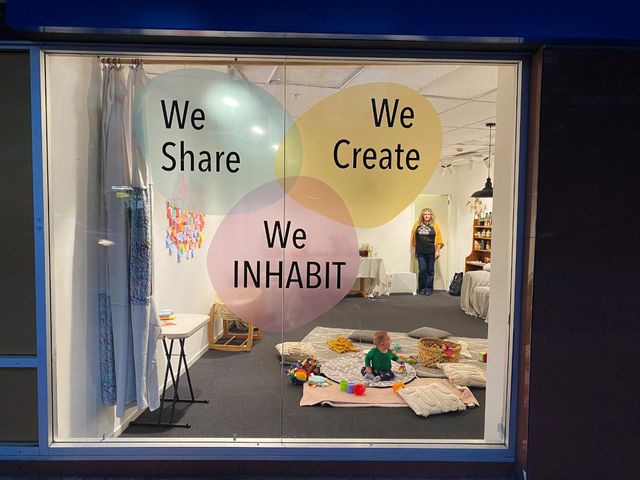
- Holly McEntegart in conversation with Anne Noble, facilitated by Mark Amery <figure class=" sqs-block-image-figure intrinsic " > Image: Anne Noble Merging her work as an artist, mother and full spectrum doula, Holli McEntegart recently brought something remarkably different to the bustle of Wellington’s Courtenay Place, in an exploration of art as a social practice. Providing a warm, calm space for participation, Inhabit brought together mothers and their infants to examine how community, cultural and whānau postpartum care has changed in Aotearoa, sharing experiences in real-time and as oral history. A private issue was brought into a public realm. Rethinking the artist’s role in society, McEntegart was supported by artist Anne Noble in a project commissioned by Letting Space for vacant space activators Urban Dream Brokerage. McEntegart now has plans to bring the project to Auckland. Here are Holli and Anne in conversation. Mark Amery Anne Noble: Letting Space and Urban Dream Brokerage have made a really remarkable contribution to the Wellington art scene. Letting Space positioned itself as an entity that sits outside the conventional domain of the gallery, where the artist is mostly defined e as a producer of objects and artefacts. They offered an experimental space and an invitation to artists to expand the ecology of contemporary art and provide support for them to provide a new kind of experience for communities and publics to engage with contemporary art I see Inhabit as a perfect example of the kind of project that Letting Space and Urban Dream Brokerage were established to nurture, enable and support. When I first thought about your ambition for Inhabit: to marry both your practices as an artist and a full spectrum doula, one of my first questions was about the expanded role of the artist in a social practice. How is your work first and foremost art while being shaped by other practices and concerns? What came to mind was a book [^1] I’ve had on my bookshelf, which has on its cover The Artist As followed by a list: that includes such descriptors of the artist as .. producer; the artist as… archivist; the artist as… ethnographer; the artist as… catalyst; the artist as… orchestrator; the artist as… poet; the artist as… curator. And it ends with this really beautiful phrase in capital letters: AND MANY OTHER THINGS FIRST. This points to the fundamental premise of your art practice - driven and formed by another whole domain of expertise, professional practice, experience and activist concerns. <figure class=" sqs-block-image-figure intrinsic " > Image: Anne Noble | Infant massage with Jo Chambers. From left: Megan Rodgers and Jasper, Jo Chambers from Blissful Bubs You define yourself as a social practice artist but you also practice as a full spectrum doula. How did you arrive at the idea of merging your practice as an artist with your life as a mother, your interest in the post-partum experience and your activism in this space? Holli McEntegart: You and I talked a lot about the artist as a conduit; or as activator. As a young artist I was always really interested in capturing images of moments that had complicated stories behind them. I realised that my interest was often more in the story; how we got to this point; the full stop. The work was always, for me, in the negotiation of getting to that image - with the image itself feeling lacklustre in comparison to that journey. Then when I moved to Pittsburgh to complete my Masters I found that there was a greater focus on social practice as a role for the artmaker. The driving need for me has always been to build relationships, and therefore community. So when I was taking photographs I would spend months getting to know people, navigating the permission, not just to be there, but to be accepted; to belong. I’ve joined every group under the sun! A loon (an aquatic bird) counting group in Maine, a porcelain painting group in Mt Albert, a bluegrass group, banjo club and a barbershop quartet in Pittsburgh, and a cake decorating group in Otara, to name a few. But I didn't feel like I had the right to be there unless I was really an accepted part of the community. That came to a head for me in Pittsburgh when I joined a semi-gated spiritualist community called Lily Dale, and began making work out of the readings they were doing for me. I would spend eight months with them before I could make that work. By the time I was living in New York there were many grants, residencies and galleries supporting a socially engaged framework of art making. My eyes were opened to the fact that this community exchange and the energy I was investing into relationship building was not only valid, it was the work.That really gave me permission to move past just documenting my work with photographs or videos and writing and to pull the focus back to the process, the making and the relationship tending. Research is a huge part of my process, whatever I’m working on I’m always off down a research tunnel. So, when I got pregnant in New York with my first child Arlo I went on a huge journey to understand pregnancy, birth and everything that was happening to my body. I discovered that in New York City, the maternal mortality rate in pregnancy, birth and early postpartum is astoundingly high, and that black women are 12 times more likely to die in childbirth than white women. OB’s are often pushing for a lot of unnecessary interventions within the hospital system and midwives are not as commonly used, though that is changing. I come from a family of home birthers in New Zealand, it was normalised and seemed like the obvious place for me to birth, but only around 1.5% of people give birth at home in the US, so it's quite a radical thing to do in that context. I was so lucky that I had a neighbour and friend who was training to be a midwife and was working as a birth doula. Through her I discovered this group of folks called doulas. I started learning about the role they play in birth work, about reproductive and birth justice advocacy, and about everything I was going to need to know to birth my baby at home while being supported by a midwife and doula team. <figure class=" sqs-block-image-figure intrinsic " > Image: Anne Noble New York City is so compact, we had a tiny apartment and I had a home studio. My son, Arlo, was born underwater, in a birth pool on my studio floor. At that point I had been working for some time within these spiritualist communities. I had been really delving into why people were seeking healing in these communities and what it meant to be constantly practising these healing rituals. Birthing my son in my studio was like an epiphany, I was on a healing journey myself and this was a part of the work. Birth was incredibly healing for me at that point in my life and then, like many people, postpartum was a completely different beast. Like most people experiencing giving birth far from their home and family, I just felt an intense lack of support from the world. And with that a deep loneliness. I was so homesick. My parents came to visit for two weeks which was incredible, but it went so fast. A few good friends showed up as best they could but I was living and working as an artist in New York, I didn’t know anyone with babies or even young kids. People are busy - for everyone else, life goes on. It’s the postpartum person that is stuck in stillness, but constantly working. It was a totally different world. You get the sense that everybody shows up for birth, everyones interested, you learn so much about pregnancy and childbirth, tracking the changes in your body all the way through to this kind of event, and then everyone leaves, and you’re left in charge of a human. It’s wild, uncharted territory and no-one’s told you that much, or what they have told you is irrelevant, biassed, outdated and sometimes even harmful. I longed for my family, mostly for my mum. I found myself floating out to sea, and there was a realisation that no one was going to rescue me - I had to rescue myself. And to do that I needed to dive even deeper into what was happening to me, go down that research tunnel again and find out what support there was in the world and how I could heal. That led to me doing Seen, a postpartum doula mentorship programme with Birdsong Brooklyn, and learning constantly - four or five months too late - what could have rescued me before I needed rescuing! It was eye opening and there was a lot of deep grief about the care I had missed out on, and the ways I could have been supported. I was diving deeply into the profoundness of becoming a mother and the reality of how much is lacking in the world in supporting new parents. I just fell in love with this idea that we could be healing collectively if we just looked after each other better and shared our knowledge. I built my community from that in New York in that first year of parenting. At that point I had been working for three years as the studio manager for an incredible artist, Janine Antoni, who is also a parent and understands that mothering work. It was a huge question for me: how do I keep working in the world as an artist, be able to show up as a mother and earn enough money to live? How do I juggle all of this and stay tethered to myself? I gave birth to my son when I was 38 and I was being called a geriatric mother by the medical system. It scared me. I wanted to breathe in my baby, just inhale him and not miss a second. But how do I do that and keep up my practice? Well… I just gave birth to my son in my studio…. It was these layers of realisation: this labour is the work. I have to reframe my life so that this labour of the home, the labour of care, of mothering, is seen and valued. So I left my job in the studio with Janine and went straight into postpartum doula training. I needed to be immersed in the community in the same way I had been with the spiritualists or the cake decorators or the bird counters in Maine. <figure class=" sqs-block-image-figure intrinsic " > Image: Holli McEntegart | Multiples Feeding Support Group. From left: Jessie Lee Broadbent, anon Anne: You have talked about your journey as a photographer engaging with communities, and how the outcome can be separated from those experiences that feel like part of the work. That is n true for many documentary photography projects.You’ve also described beautifully your dissatisfaction with being both outside a subject and yet needing to be right in the heart of it. The notion of a social practice artist is less common in New Zealand than in the US. It has currency in art schools, but my instinct when we first met and talked was that you have a really highly evolved practice in which you prioritise your relationship as an artist to the post-partum communities you engage with Your work begins with you your life as a mother and your practice as a doula being the site of public art activism, of making the post-partum world experience shared and visible. How have you then addressed the visibility of this as an artwork? You only need to look at the project website to see the level of community engagement and the number of people you have drawn into this space. It’s really significant. Those workshops - people flocked to them. But to make it public, visible to participants and to audiences how does that work? Holli: What comes first for me is the relationship, being a good community member and trust. I come at relationship building and getting people involved with their whole heart; with a genuine interest and respect. I have to have something at risk as well. Inhabit was a year in the making, but the day we opened, with a multiples lactation support workshop. We had six twin mums and probably six assistants or helpers, including grandmas, friends, lactation and doula support. That's 12 babies plus Indigo [Holli’s own baby]. Over 24 bodies breathing life into the space. That was the moment that the work became art; that it became an artwork. It was activated by the community of people in the room and their energy. Up until then there’s a lot of risk on my part because I don’t know who is going to show up and what they will bring on the day. The work is filled with intention but it has to meet people where they are and vice versa, and for that reason, it’s never the same, it evolves and unfolds and, much like mothering, I must surrender to it. I think I’m comfortable leaning into the unknown. Within a socially engaged practice you really don’t know how your participants or your audience (the public) are going to enter the work. I consider the folks facilitating workshops my co-creators. There were six months of emailing and zoom conversations about what I was making with that final group of people, so many conversations about what the community needed. And then there was a point when they came to me with a plan to set up this specific workshop for multiples families. They were asking for my permission, and I was overjoyed because, it was at that point that they took ownership and really began to have agency within the work. That was the moment when the community was activated, they started creating what they needed under the umbrella that I offered - this community activation was where the social practice aspect of the work really came into play. <figure class=" sqs-block-image-figure intrinsic " > Image: Milan Maric | Combined yoga and Infant massage workshop with Emma Chen Flitcroft and Jo Chambers I was coming to Wellington, into a community I’m not from, so I’m constantly asking myself, how do I leave this space better than when I got here? Within social practice I think there is a very real responsibility to care for the community you're working in and to make sure there are ongoing care agreements in that community. Everyone that provided a workshop for Inhabit offers free or sliding scale services that could continue to be accessed after Inhabit closed for example. Anne: That’s a beautiful description of the artist as catalyst. I’m very fond of the notion that when an artist plays those roles, the artist in a conventional sense disappears to become a generating and catalysing force Holli: I’m interested in the way my role shifted from facilitator to participant, or mother , or host. Hourly that changed. Originally I thought I would be facilitating some workshops but I didn't end up doing that because so many people wanted to facilitate their own. At the beginning of each workshop I would introduce the project and really ground it back into the context of an artwork, to remind people they were participating in something both bigger than them, but also inherently generated by them, and then I would participate alongside them. I was never an observer, I was a participant. I think it’s really important I have the ability to be part of what’s happening as opposed to being an outsider. Learning, participating and being vulnerable. That vulnerability permissions other people in the space to also be vulnerable. It’s not like, as you’re describing Anne, that ‘‘you’re the artist and you’re over there’ on a pedestal. The process is about me sinking back into the work. It’s a dance between making sure people feel like they are being held and acknowledged and the space is being tended to in the correct way, but not dominating it. <figure class=" sqs-block-image-figure intrinsic " > Image: Anne Noble Anne: As a public artwork, positioned in Courtenay Place, it was a really beautiful intervention with really subtle signage and this glowing light masked by a wall of handmade stitched together nappies! It offered a surprising encounter that was intriguingly signposted and people were welcomed to just stop and to consider what it might be - as a public art project. Sometimes I was amazed at the number of people participating and how the work created an opportunity for a community to assemble. How did you introduce participants to the process of being part of something for them but also part of something larger? Of being participants and collaborators in Inhabit as an artwork. Holli: That was definitely one of my biggest challenges. There were a couple of things I did practically. Even before Inhabit opened I worked very hard to centre the project in the community with this drawing project that involved - six Love Note posters that were plastered repetitively around the city in the two weeks leading up to our opening. I was documenting them in situ and sending images of them to people when they were signing up for the workshops as well as using them in social media. So there was a centring of it as an art project before they arrived. Most people had seen these drawings and then saw the wall of Love Notes growing on the wall when they came into the space. I introduced that as a collaborative drawing project and really impressed the importance of adding everyone's voice to that growing archive. <figure class=" sqs-block-image-figure intrinsic " > Image: Lily Dowd I constantly was re-centring it as an artwork in this way all the time, and encouraging the public to participate, reminding them of what they are a part of. I see the Love Notes as the beginning of an archive of postpartum stories - a collection. And that maybe this is how we start something: a movement, a book, an archive - we just have to start putting our stories on the wall. I think that grew really organically and became a way for people to gently be reminded of the fact that they were a part of an artwork, and then they forgot about it - which was great. Someone hands them a bowl of soup, nourishes them, checks in and makes sure they’re OK. Offers to hold their baby. and that energy of care flows into the space and people feel really comfortable. And that comfort was there in part because I was there visibly parenting, making the work. Creating a space that makes visible the lived experience of parenting, and artmaking at the same time. <figure class=" sqs-block-image-figure intrinsic " > Image: Anne Noble As it transpired there was very little foot traffic, and actually the space needed to be very protected, intimate and gate kept. So the curtain that I made really provided a level of intimacy. It is another drawing project I had been working on as a part of the show, but I didn’t quite know where it would fit. I’ve been collecting these used flat nappies. They are very identifiable, heavily washed and starched white cotton with a red stripe down the side. They are the kind of do everything cloth of motherhood. So representative of the labour of the home. Soaking up the mess of it all. I’ve been stamping all over them with my own mother at my kitchen table, “Ssshhhhhh sshhh shhh ssshhh shh shh shh…” On the first day of installation it was clear to me that we needed to be able to transform the space into a private, intimate one, and to open it up to the world. Sewing the nappies together to make a curtain was a wonderful way to create that boundary between public and private. And then at the end of the last workshop I was really inspired to “pull back that curtain” and be seen. I called you and asked you to document this moment of being seen in parenting and artmaking. It was such a moment of connectivity and community connection. There’s now two groups I believe that came together at Inhabit and are continuing to meet. It was great to cultivate this level of nurturance and community engagement in a place like Courtenay Place - buses, cars and people with so much going-to-work energy, once we pulled back that curtain I think people were taken aback by it “there are so many babies!” <figure class=" sqs-block-image-figure intrinsic " > Image: Milan Maric | Combined yoga and Infant massage workshop with Emma Chen Flitcroft and Jo Chambers Anne: Yes it was a brightly lit window that glowed like a little jewel! And was such a surprising experience walking by. You’ve described the artist as a generator and how there is a legacy for participants beyond the exhibition space. What were some of the highpoints during Inhabit and some of those legacies? Holli: The highest high was our opening, that first day. 13 babies in the space. One of the sets of twins was only five weeks old and it was their first time out of the house and their mum had driven an hour to get there, they spent all day with us. Any future Inhabit projects will always open with a multiples workshop because these folks are the least catered for within the system. The world was not made for people birthing two or three babies at a time… So to have this space where people were surrounded by support and advice and understanding. It was so magic and it was so clear there was a need for that. I think that in the current Covid climate people are feeling so much more isolated and unable to get out of the house. Opportunities for connection that were available to parents pre covid often aren't now, like community or library meetups and coffee groups. Many people were speaking of coming to Inhabit as the first time they’d been to a group outside the home, there is a lot of isolation and fear out there, and a deep lack in support services. A few people who weren’t parents had some very interesting interactions with the space as an artwork, which I found fascinating. Some really generative conversations came from them being confronted: that they were coming to a public exhibition, and were questioning ‘what is this?!’ I had very interesting conversations with other artists about what participation looks like when you’re not a parent. For parents their participation was organic but for others, it felt very different. They accessed it through my facilitation and it was interesting seeing them sink into comfort because they were being cared for; getting down on the floor and playing with Indigo. Having some soup, and learning about traditions of postpartum care and methodologies. I’m interested in pulling back the veil on this kind of care work because we can all benefit from learning how to tend to our communities and families. <figure class=" sqs-block-image-figure intrinsic " > Image: Milan Maric Another highlight was my involvement with Little Shadow. They run perinatal mental health support groups in the Wellington region and virtually across the motu. They were so supportive of this project. They really saw the power of what Inhabit created in offering an entrance point to conversations about perinatal mental health that are softer and more nurturing than how it’s often tackled when people are looking for support within a healthcare system. Inhabit provides nourishing food, a space to express yourself creatively, a place to move your postpartum body, and a room full of folks on a similar path. Once there, we are able to get into the nitty gritty of what we are all experiencing because the space itself is so tended to. Something that I repeat all the time is that I’m examining patterns of care, whilst caring for our communities. I want to decolonise postpartum care so that we may all gain the knowledge of how to care for each other. Then there was that final reveal, pulling back that curtain. I felt I was truly being seen as my whole self in the work. Before that point I was a shapeshifter facilitating everybody else's journey. But at that moment I was in my deeply creative space of making and mothering as I finished the project. It felt like closure and an answer to that question of how I can be an artist, make work and be a parent. It struck me how that question has deeply impacted my relationships with people and how I move in the world. In my first few days in Wellington I had a clear vision of that image we captured at the end. I saw the room glowing with light, semi dark outside and the interior being a place of making and of process. A gallery, and a living room and a studio and a feeding place. Where bums are getting changed, a place where all of life is happening at the same time. And that the public are walking past and peeking in. The labour of parenthood and of artmaking is usually so invisible. That moment at the end just felt like: let’s get it all on display! <figure class=" sqs-block-image-figure intrinsic " > Image: Milan Maric <figure class=" sqs-block-image-figure intrinsic " > Image: Milan Maric Anne: I love what you say about risk. Because if art doesn't involve risk it doesn't leave the opportunity for engagement - If it's there and says it all it doesn’t ask very much of people. The way both your processes of making and lived experience are entirely central to the work raises questions for people coming in off the street - challenging their notions about art - and confronts them with the invisibility of the post-partum experience. Can you talk about how Inhabit is an evolving work? How it’s more than a one-off event where communities come together and are potentially transformed. How is the website a part of the evolution of the work? Holli: If you are thinking about community engagement and looking at different types of communities' needs then you’ve got to move around those communities. My vision for Inhabit was always that it would move around the motu. One of the things I thought was important about the experience in Wellington was that it felt disruptive. It felt radical. It was an interesting way to inhabit vacant space in the CBD and disrupt a community. It ignited something that people were aware they needed, but no-one knew how to connect on and build. <figure class=" sqs-block-image-figure intrinsic " > Image: Anne Noble I think there’s a lot of power in Inhabit travelling around regionally and disrupting systems in ways that are really positive and ignite connection. I think of little things growing, sprouting. And of having this homebase of an archive online where we can collect and hold these postpartum stories and learn from what we’ve been doing here to better support communities. Anne: Thanks Holli - for the pleasure of being a small part of this project with you. Anne Noble (Laureate), ONZM, is a photographer and curator whose work spans still and moving image, installation and international curatorial commissions. Over multiple projects Annne Noble has considered the significance of memory and imagination to personal and cultural narratives of place and belonging.Holli McEntegart is an interdisciplinary artist using social practice, video, performance, photography and text. She holds a Bachelor of Visual Arts in Photography (NZ), and a Masters of Visual Art and Design from Auckland University of Technology (NZ), which included a one year MFA scholarship at Carnegie Mellon School of Art, Pittsburgh (USA). In 2014 she was an artist in residence at the Skowhegan School of Painting & Sculpture in Maine (USA). Her work has been performed and exhibited throughout the USA and New Zealand. In 2018 she trained as a Full Spectrum Doula after giving birth to her first son in Brooklyn, New York. Returning to Aotearoa in 2020, where she continues her work as an artist and as a Reproductive Justice Advocate. Holli is now an island named Mother to two boys, aged 4 and 9 months. <figure class=" sqs-block-image-figure intrinsic " > Image: Holli McEntegart | Multiples Feeding Support Group - From left; Anon, Georgie Manning, Jessie [^1]: Aileen Burns, Tara McDowell, and Johan Lundh, The Artist As Producer, Quarry, Thread, Director, Writer, Orchestrator, Ethnographer, Choreographer, Poet, Archivist, Forger, Curator, and Many Other Things First. Institute of Modern Art, Brisbane, Curatorial Practice at Monash University, Melbourne and Sternberg Press, 2018.
- Accepted from Urban Dream Brokerage Blog by feedreader
- Tagged as:
- brooklyn
- covid-19
- exhibitions
- libraries
Brooklyn, Wellington, New Zealand (OpenStreetMap)
-
631 - 631 of 631
Matching websites
-
-
Wellington Live Music
- Wellington Live Music is a community blog consisting of reviews, interviews and photographs from buskers to professional gigs via open mic nights and festivals. Written by Charlette Hannah and guest writers.
- Tagged as:
- music
- blogs
-
-
-
Live Wellington - a liveable city by design
- LIVE WELLington rejects the current winner-take-all, deregulatory philosophy of blanket upzoning and opposes plans to remove people’s rights to have a say on developments. Instead of this radical and divisive agenda LIVE WELLington proposes proper planning and partnerships to do density well.
- Submitted by tonytw1
- Tagged as:
- draft-spatial-plan
- lobby-groups
-
-
-
INNER-CITY WELLINGTON
- We represent the residents, organisations and property owners who live, own and operate in the inner city community.
- Submitted by tonytw1
- Tagged as:
- community-groups
-
-
-
San Francisco Bathhouse
- The San Francisco Bath House, formally known as Indigo Bar and Venue, is Wellington’s premiere live music venue.
- Tagged as:
- restaurants-and-bars
- cuba-street
- music
-
-
-
The Performance Arcade
- Founded in 2011, The Performance Arcade is a free, award-winning festival of live art, music and performance on the Wellington Waterfront.
- Submitted by tonytw1
- Tagged as:
- events
- waterfront
-
-
-
Wellington Civic Trust
- The Wellington Civic Trust was established with the aim of making Wellington the best place to work and live in New Zealand!
- Tagged as:
- lobby-groups
-
-
-
Stirling Real Estate Limited MREINZ
- Stirling Real Estate Limited commenced business in Lower Hutt, New Zealand in 1996. The company is locally owned and operated, and all our salespeople live in the community we serve.
- Tagged as:
- hutt-valley
- estate-agents
-
-
-
Enterprise Miramar Peninsula
- Enterprise Miramar Peninsula is an innovative community led project in Wellington, New Zealand. We have a vision for how our Peninsula can enrich the lives of those who live, work and play here.
- Submitted by tonytw1
- Tagged as:
- miramar
- professional-organisations
-
-
-
Wellington Women's House
- The Wellington Women's Boarding House provides safe, pleasant accommodation for women on low incomes. With a live in manager, the big old house in Mt Victoria offers comfort, companionship, protection and independence at the same time.
- Tagged as:
- art
- womens
-
-
-
King's Church Wellington
- We are people who’s lives have been changed through meeting and knowing Jesus Christ. If you live in the Wellington region or are here on a visit we invite you to come and check us out.
- Tagged as:
- religious-groups
-
-
-
Ian McKinnon
- City Councillor - Lambton Ward. Jenny and Ian live in Te Aro and have two adult children. His primary career was in education at senior levels, giving him considerable experience in senior management and governance, including finance.
- Submitted by tonytw1
- Tagged as:
- election-candiates-2010
-
-
-
Wellington Commuter
- Wellington Commuter is the personal blog of Tony Randle. As you might expect, I live in a suburb of Wellington City, New Zealand. I have a suburban home but work in the Wellington CBD about 10 kilometres away
- Submitted by tonytw1
- Tagged as:
- blogs
- transport
-
-
-
Newtown Residents' Association
- The Newtown Residents Association is a group of local residents who gather together to express the views of local residents on a wide range of matters that might impact on the community in which we live, work and play.
- Tagged as:
- community-groups
- newtown
-
-
-
Capital E
- Capital E is the only organisation in New Zealand that gives children access to such a wide range of creative technology and live performance. It is an award-winning facility, based in Wellington, New Zealand, attracting up to 200,000 visitors each year.
- Tagged as:
- education
-
-
-
St Peter's Anglican Church
- We are an Anglican Church that has stood watch on Willis Street since 1848. We have helped the city grow up around us and we are committed to making this a very human part of Wellington in which to live and work.
- Tagged as:
- anglican
-
-
-
Island Bay Marine Education Centre
- The primary objectives of the Island Bay Marine Education Centre are to promote interest in, increase knowledge and understanding of, and encourage protection, enhancement, and enjoyment of local, national, and global marine environments through public education programmes, live displays, and community initiated research and service projects.
- Tagged as:
- marine-education-centre
- education
- island-bay
-
-
-
Free online market appraisal of your home
- David Garratt is a residential real estate marketing manager with ten years of experience selling homes in Wellington's Northern Suburbs. If you live in this area and would like an accurate indication of market value for your home with accompanying sales statistics, visit www.northernsuburbs.co.nz today and register
- Tagged as:
- johnsonville
- estate-agents
-
-
-
Sustainable Wellington Transport
- This blog is run and maintained by Sustainable Wellington Region Transport (sustwelltrans), a group of people from the Wellington region intent on seeing a sustainable, prudent and long-term approach to transport in our region. Our members live in the Hutt, Kapiti, Porirua and Wellington City.
- Submitted by tonytw1
- Tagged as:
- blogs
- transport
-
-
-
Sustainable Wellington Transport
- This blog is run and maintained by Sustainable Wellington Region Transport (sustwelltrans), a group of people from the Wellington region intent on seeing a sustainable, prudent and long-term approach to transport in our region. Our members live in the Hutt, Kapiti, Porirua and Wellington City.
- Submitted by tonytw1
- Tagged as:
- transport
- lobby-groups
- kapiti
- porirua
-
-
-
New Zealand Vegetarian Society - Wellington Branch
- We are a group of vegetarians and vegans who live in this creative and vibrant region of New Zealand. Our aim is to promote vegetarianism as well as to offer social activities, advice and support to our members and those interested in learning about or adopting this healthy and humane lifestyle.
- Tagged as:
- community-groups
-
-
-
Wellington Russian Club
- Our aim is to share knowledge about Russian culture with New Zealanders and keeping Russian language through the generations. Founded in 2000, the Wellington Russian Club helps new settlers from Russia who have arrived in Wellington to live and work with information, support and knowledge of New Zealand culture. We invite them to be part of our wonderful programmes and events.
- Tagged as:
- ethnic-groups
-
-
-
Blackdog Design
- We are a small graphic design company based in Wellington, with a view of the world. Our aim is to help and become an integral part of making you and your ideas great through thoughtful and creative design. Our name stems from a love of Black Labradors and in the way that they live: they are loyal, love unconditionally and will follow you anywhere.
- Submitted by tonytw1
- Tagged as:
- design
-
-
-
Grow Wellington
- Our aim is to drive growth in exports, to help create a strong and vibrant Wellington regional economy to be enjoyed by all who visit, live, and work here. We work with individual businesses, and develop centres of excellence and other larger projects involving industry groups and sectors. If you are an entrepreneur looking to liberate your big idea and turn your dreams into a succesful business then our Activate programme is for you.
- Tagged as:
- business
-
-
-
A City for People
- Decades of inaction have meant house prices are out of control, while old rental properties rot out from underneath us. A whole generation of people are at risk of being forced out from the central city into new suburbs sprawling north, spending hours every day in traffic jams. We believe the Spatial Plan will allow Wellington to plan for the future so that new generations of Wellingtonians can share the city we love, and have a chance to live in a home that is affordable, accessible, healthy and warm.
- Submitted by tonytw1
- Tagged as:
- draft-spatial-plan
- housing
- lobby-groups
-
-
-
The Great Hoax
- "The Great Hoax" is made up of SIKNIK{www.myspace.com/musicsiknik} on Vocals/keys and Chris Nowland on guitar. Vocalist, keys, and guitarist Nick Swanson has been around the NZ music scene for a number of years, under the artist name “SIKNIK”, and in 2007, released “The Beats in your Brain ep”, scoring himself an interview and feature on UPFM’s “Beat Dungeon” and landed himself on “Beat dungeons” compilation “sonic confinement, aswell getting radio play across the country, mainly on student/youth orientated stations. Lead Guitarist Chris Nowland has also been around the wellington scene for a number of years, performing in various café and bars across the city!, Chris’s main focus of guitar to this point has been guitar solos and ballads, and ads something unique to “The Great Hoax”. Earlier on in the year, the two decided to team up together to make music and play covers of artists the both enjoyed, the first of tributes is of Leonard cohen’s music, to debut to “The Welsh Dragon” on NOV the 27th. The two also plays their own original songs around the place, and are open to any sort of gigs. “our music, is quite versatile, I mean we can play acoustic versions to our songs, or electro, or with a full band”, genres and styles range from folk acoustic, electronic dance/psychedic, and rock. “We play live around wellington, and are currently working on a debut CD
- Tagged as:
- music
-